What AI Is Telling Your Customers Their Trade Is Worth — And How To Win That Conversation
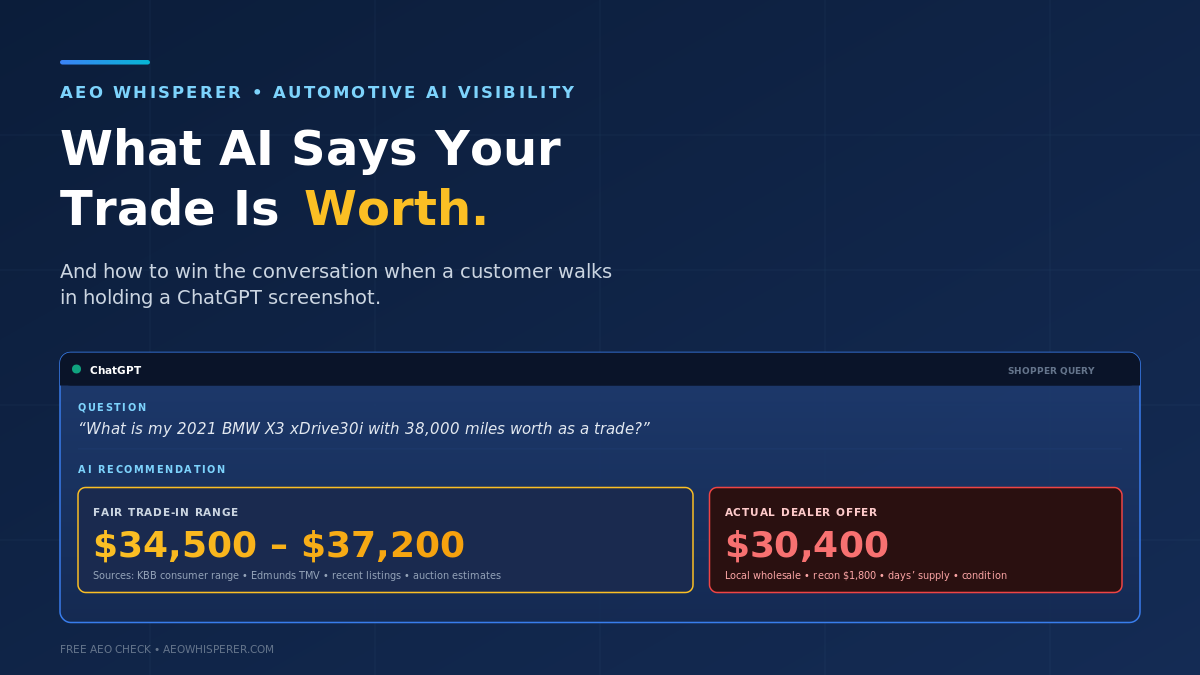
Last Saturday a couple walked into my showroom with a 2021 X3 they wanted to trade. Nothing unusual about that. What was unusual was the screenshot they were holding — a ChatGPT conversation that pegged their car at a "fair trade range" of $34,500 to $37,200, complete with a paragraph explaining where the number came from. Our appraisal came in at $30,400. By the time the manager walked over, the customer had already decided we were trying to lowball them. We weren't. The market wasn't. But the AI had set the anchor before we ever got to the desk.
If you're a GM and you haven't had that conversation yet, you're about to. This is the new walk-in.
Where the AI number actually comes from
The thing that bothers me most about these screenshots is that they look authoritative — clean prose, a confident range, a tidy rationale — but they're built on a stack of inputs that nobody at the customer's end is auditing. When I pulled apart what ChatGPT, Gemini, and Claude were citing for trade-in values this month, I saw the same handful of sources doing most of the work: Kelley Blue Book consumer ranges, Edmunds True Market Value, third-party auction data that may or may not be current, asking-price scrapes from public inventory listings, and a layer of model "judgment" on top.
Two things to know about that stack. First, asking-price scrapes are not transaction prices — they're what other dealers are advertising, which is consistently above what cars are actually selling for. Second, none of these sources see your local wholesale market, your specific condition assessment, or the reconditioning your store has to do before that car can hit your retail line. The model is averaging public-facing numbers and presenting them as private market value. That's not a small gap, and it's costing deals.
Why customers trust it anyway
Here's the part every GM needs to internalize. Customers aren't checking three sources, weighing them, and forming a view — they're asking one question, getting one paragraph, and treating it as the answer. The act of "research" has compressed from forty-five minutes of clicking around to one prompt. And conviction is higher than it was with KBB alone, because the AI delivers it in confident, conversational language. They believe it more, even though the underlying data is often worse.
This is the AEO problem showing up at the desk instead of at the keyboard. Whatever AI tells a shopper before they walk in is the frame the deal happens inside. You're not negotiating from a clean sheet — you're negotiating against a number a customer already trusts.
The three moves I'd make this month
If I were starting this from zero, I'd do three things. None of them require new tooling — they're the kind of thing every GM can put on the next sales meeting agenda.
First, build a real trade-in explainer on your site and make it AEO-friendly. Not a generic "we'll appraise your car" paragraph — an actual breakdown of what goes into your number, including reconditioning, days' supply on that vehicle in your region, condition adjustments, and why your offer can move based on certified eligibility. AI models cite content that explains a process. They generalize past content that doesn't. If your trade page reads like every other dealer's trade page, you don't show up.
Second, train the desk to lead with the model's blind spots, not to argue with it. When the customer's holding that screenshot, the worst thing a manager can do is tell them the AI is wrong. The right move is to acknowledge where the number came from, then walk through the two or three things the model didn't see — condition specifics, your auction reality this week, the actual transaction price on the last three of those cars wholesaled out of your store. That conversation builds trust. Arguing with ChatGPT does not.
Third, get your reconditioning costs and process into "about" or "how-it-works" content somewhere AI can find it. Right now the models have no idea that a 2019 with 78,000 miles needs $1,800 in recon before it can hit your retail line. That dollar amount, written into your site in plain English, gives the model something concrete to consider next time it generates a trade range — and gives your salespeople a piece of public evidence to point at during the deal.
The bigger picture
The trade-in conversation is just the first place this is going to bite. Lease residuals, payment estimates, finance terms, certified pre-owned premiums — every one of those numbers is now being generated by AI for shoppers before they ever fill out a form. Stores that get the AEO basics right will quietly own those conversations. Stores that don't will keep fighting screenshots at the desk.
If you want to see what AI is telling shoppers about your store specifically — including how the trade conversation gets framed in your market — the free AEO check at aeowhisperer.com will run the queries across ChatGPT, Claude, and Gemini and show you exactly where you sit. It takes about a minute. The number you see may surprise you. It may also explain the last three deals you lost.