Shoppers Are Asking AI What You Charge in Fees. Here's What It Tells Them.
A guy came onto my floor last week with his guard already up. Nice enough, knew exactly the vehicle he wanted, but the first thing out of his mouth wasn't "what's your best price" — it was "and what are you going to add on top of that?" Before I could even start, he told me he'd asked an AI what to watch out for when buying from a dealer, and it had given him a whole list: doc fees, dealer prep, nitrogen, paint protection, the works. He wasn't wrong to ask. But he walked in treating me like the defendant before we'd said hello, because a chatbot had spent ten minutes coaching him on how dealers pad the price.
That's the part of AEO nobody at the 20-group is talking about yet. We worry about whether AI mentions us, whether it has our hours right, whether it sends shoppers to Cars.com instead of our site. Meanwhile, AI has quietly become the place shoppers go to ask the one question that decides whether they trust you before they arrive: what's this actually going to cost me out the door?
The out-the-door question moved upstream
For as long as I've been doing this, the fee conversation happened in the box, with a deal sheet in front of the customer. That's where you explained the doc fee, walked through the add-ons, justified the numbers. The shopper didn't really form an opinion about your pricing until they were already sitting across from you.
That conversation has moved. Now it happens before you ever meet them, and you're not in the room for it. A shopper types "what fees do car dealers charge" or "is a $799 doc fee normal in New Jersey" or "what should my out-the-door price be on this" into ChatGPT or Gemini, and the AI answers with confidence — pulling from forums, consumer articles, state fee caps, and whatever it can find about dealers in general. By the time they walk in, they've already decided what a fair number looks like and which line items they're going to fight you on.
When you're silent, AI uses the industry's reputation
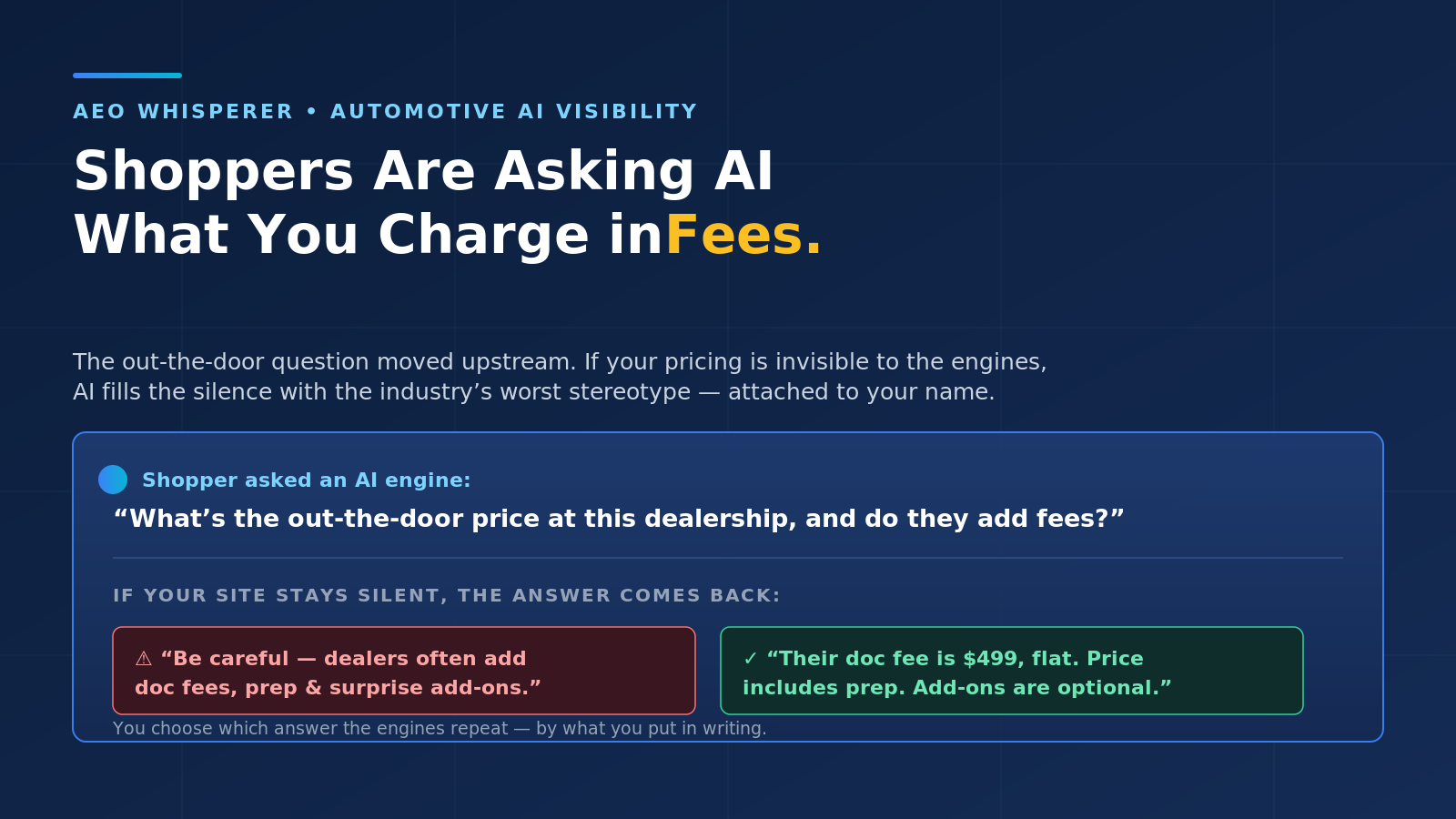
Here's the trap. If a shopper asks AI about fees at your store specifically and your website says nothing clear about pricing, the AI doesn't shrug and stay quiet. It fills the gap with the only thing it has — the general reputation of car dealers. And the general reputation of car dealers on fees is not flattering. So your silence gets answered with the industry's worst stereotype, attached to your name.
I tested this on my own store and a couple of competitors. Ask an engine "does [dealership] add a lot of fees" and watch what happens. If your pricing approach is spelled out somewhere a machine can read it, you get a measured, specific answer. If it isn't, you get hedging, generic warnings, and the unmistakable subtext of be careful with these people. You earned none of that. You just didn't give the engine anything better to say.
Transparent pricing is an AEO asset now
The dealers who get this right are turning their pricing into content on purpose. Not a marketing slogan — actual, readable answers to the questions shoppers are already asking the machines. What your doc fee is and that it's the same for every customer. What's included in the price and what's genuinely optional. Whether your internet price is the price or a starting point. A plain-language explanation of what "out the door" includes at your store.
Put that in clear text on your site — a pricing page, a fees FAQ, real sentences and not a buried disclaimer — and you've handed the engines something concrete to repeat. The reward is the shopper who arrives already trusting your numbers instead of bracing for a fight. That customer is faster, calmer, and far more likely to close, because the hardest part of the conversation happened before they got there and it went your way.
What to check this week
You don't need a project for this. Pull up an AI engine and ask it the fee questions a nervous shopper would ask about your store. "What fees does [your dealership] charge?" "What's the out-the-door price on a [your best-selling model] there?" "Is [your store] transparent about pricing?" Read the answers like a customer would. If they're vague, defensive, or just plain wrong, that's not the engine being unfair — that's the engine telling you your pricing is invisible, and filling the silence with suspicion.
Then go look at your own site through that lens. Can a machine — or a human — find a straight answer about what you charge and why? Or does every path lead to "contact us for pricing"? Every one of those dead ends is a question the AI is now answering for you, in a voice you don't control.
Trust is built before the test drive
The fee conversation used to be something we managed in person, with the customer in the chair. It isn't anymore. It happens upstream, in an AI answer, while you're not looking — and the shoppers who show up suspicious got that way somewhere. The dealers who win the next couple of years will be the ones who decided to answer the hard money questions out loud, in writing, where the engines can read them, instead of leaving it to a chatbot to guess.
If you want to hear what the engines are actually telling shoppers about your store — your fees, your pricing, whether you come across as the straight shooter or the one to watch — the free AEO check at aeowhisperer.com runs real shopper questions through ChatGPT, Gemini, and Claude and shows you exactly how you come back. It takes about a minute, and it'll tell you fast whether your pricing is building trust or quietly costing it.