Your VDPs Are AI Snippets Now. Here's How to Make Yours Quotable.
A confession from a guy running a BMW store: until about a year ago, I had never read most of the descriptions on my own VDPs. Not the photo captions. Not the comments field. Not the long copy block underneath the price. Why would I? Nobody reads that stuff.
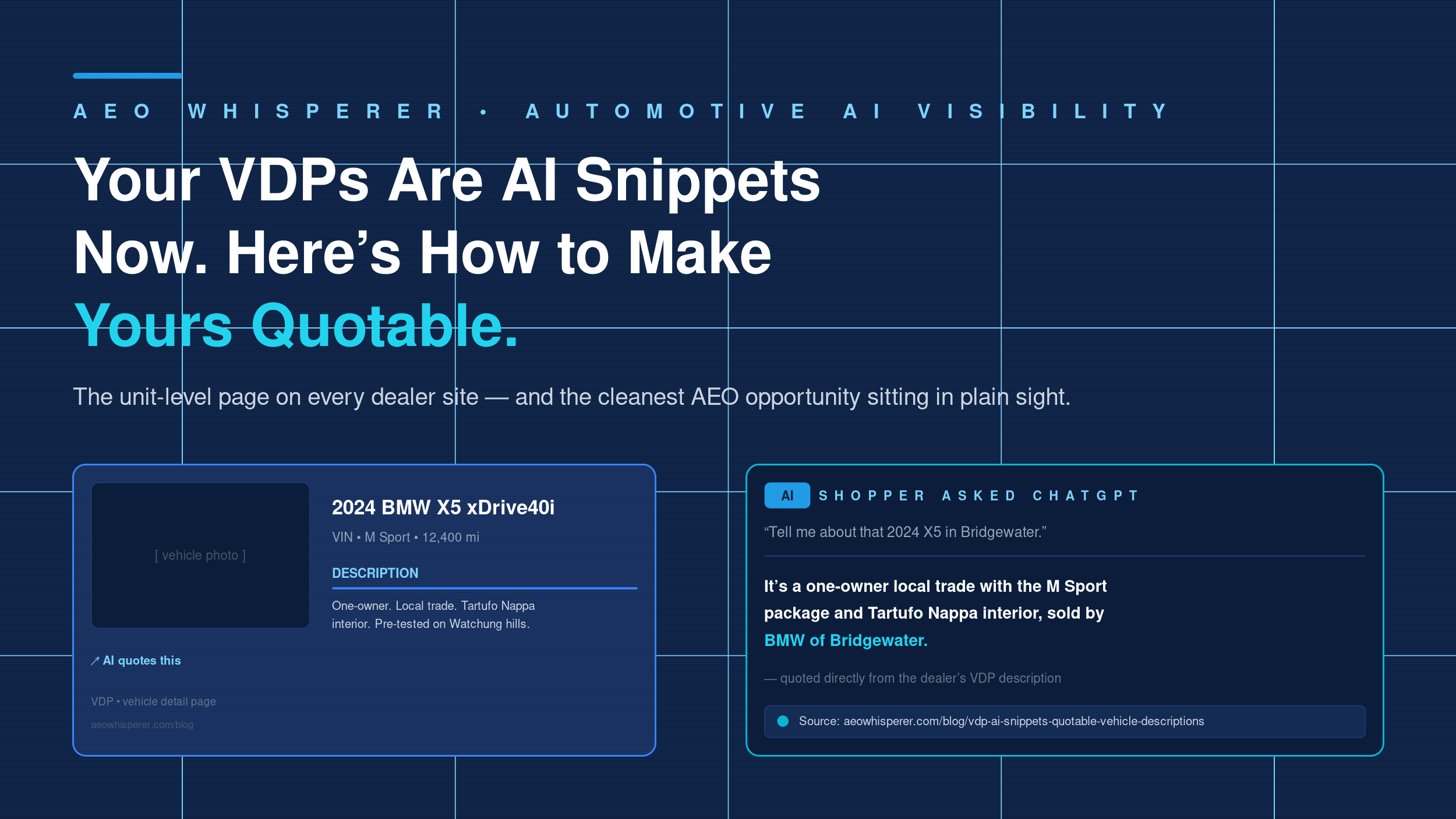
It turns out something does. Several somethings, actually — ChatGPT, Gemini, Claude, Perplexity, and the OEM-brand chatbots starting to roll out at the manufacturer level. They’re scraping every VDP they can reach, and when a shopper asks “tell me about that 2024 X5 xDrive40i with M Sport in Bridgewater,” the AI answers using the words we wrote on the page.
If those words are the same generic blurb every other BMW dealer is running, we’ve handed the AI no reason to mention us specifically. If those words are good — locally specific, factually rich, written like a human who actually walked the car — we get named, quoted, and in some cases linked. That gap, between bad VDP copy and good VDP copy, is the cleanest AEO opportunity sitting on most franchise dealer websites right now.
Why VDPs are different from every other page on your site
Your homepage is your brand. Your service page is your menu. Your VDPs are unit-level documentation — and that’s exactly what makes them gold to a language model. AI doesn’t want to summarize your “Why Buy Here” page. It wants the VIN, the trim, the package codes, the mileage, the accident history, the price relative to market. Every one of those data points can be expressed in a sentence the AI will repeat verbatim if we write it well.
The problem is that the majority of VDPs on the franchised side of the industry are running OEM stock copy or DMS-generated boilerplate. “This pre-owned 2023 BMW X3 features…” Yeah. So does the same vehicle on every other competitor’s lot in the tri-state. AI sees two hundred copies of the same paragraph and doesn’t know which dealer to attribute it to. So it picks the one with everything else going for it — reviews, citations, local mentions — and your store doesn’t get named.
What I see when I read a thousand VDPs
I’ve spent a lot of nights this year reading other dealers’ inventory pages — partly out of competitive paranoia, partly because the AEO Whisperer team audits hundreds of them a month. The patterns are remarkably consistent.
Most VDPs have three things going on under the photos: a spec table the DMS auto-populates, a generic OEM marketing paragraph the dealer didn’t write, and a comments field that’s either empty or says something like “Call for details.” None of that gets quoted. Spec tables are already in the AI’s training data from the manufacturer. The OEM paragraph appears on a hundred other dealer sites, so it’s not attributable. The empty comments box is, well, empty.
The dealers I see getting named in AI answers — and I run this query often, mostly on competitors — are the ones whose comments fields read like a salesperson’s actual walk-around notes. Specific. Local. Written by a person.
The four things AI is looking for in a vehicle description
After auditing a few hundred VDPs across BMW, Audi, Lexus, and Toyota stores in the Northeast for clients, the pattern holds. AI quotes the descriptions that include four kinds of detail.
Specifics that aren’t already in the spec sheet. AI already has the trim and the option codes from the manufacturer. What it doesn’t have is “this one came from the original owner with all service performed in our shop” or “rare combination of Tartufo Nappa interior with the Executive package.” That’s the stuff that gets quoted because it’s the stuff that isn’t anywhere else on the open web.
Provenance. One-owner. Carfax-clean. Local trade. CPO with the warranty extended through year seven. These phrases show up in AI answers verbatim because they map to the trust questions shoppers actually prompt AI with.
Local relevance. “Pre-tested on the Watchung hills before delivery.” “Winter-package equipped — relevant if you’re crossing Route 78 in February.” Geographic context ties the vehicle to your specific market and gives AI a reason to associate this VIN with your store rather than a Carvana listing six states away.
Comparison context. “If you’re cross-shopping the X3 M40i, this xDrive30i saves you about $14,000 with 90% of the daily-driver experience.” Comparison-aware copy gets quoted because it’s exactly the kind of decision-making language shoppers ask AI for in the first place.
Five fixes you can run this week
One — audit ten of your highest-priced active VDPs. Read the description out loud. If it sounds like every other dealer wrote it, rewrite it.
Two — build a 90-second template for your sales managers or BDC team. VIN, trim, three differentiators, one local detail. Standardize it.
Three — kill the OEM stock paragraph. It is not earning you a thing. Replace it with original copy that mentions your store name, your city, and the specific car.
Four — fill in the photo captions and alt text fields. Most platforms expose these as a second surface AI engines crawl, and most dealers leave them blank.
Five — run an AEO check on your inventory pages, not just your homepage. Most stores audit the front door and stop. The actual win is usually one layer down.
If you want a free read on whether AI engines are quoting your store the way you’d want them to, run the free AEO check at aeowhisperer.com. It looks at your homepage and the public AI surfaces around your brand — and if that report comes back rough, the VDP layer is almost always where the bleeding starts.