9 Months, 6 Algorithm Updates: The Evolution of AI Visibility Scoring
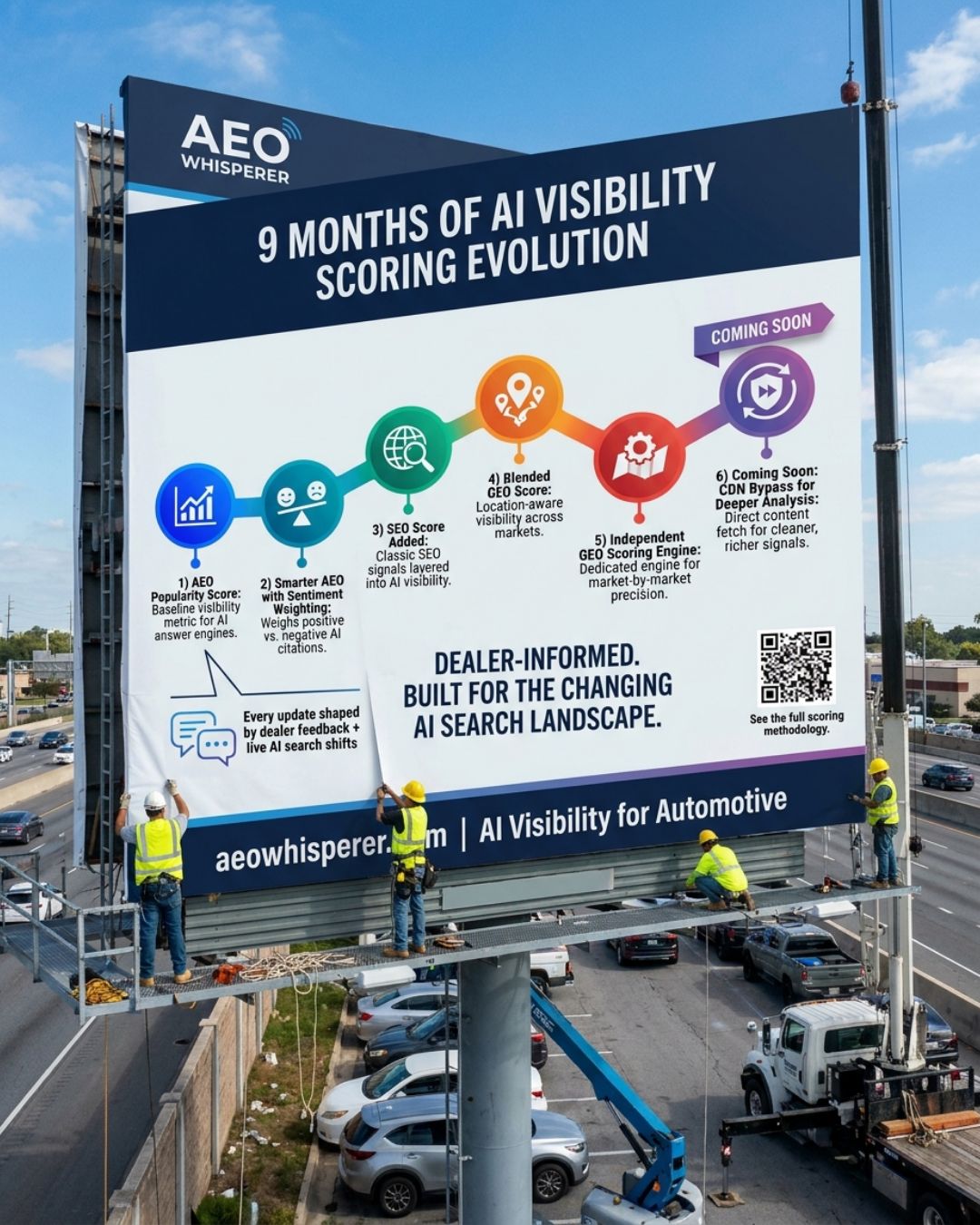
Nine months ago, AEO Whisperer didn't exist. The idea was simple: car shoppers were starting to ask AI where to buy their next vehicle, and most dealers had no idea what the answer was — or whether they were even in it.
Today, after six major algorithm updates and more minor revisions than I can count, the platform scores dealerships across three independent AI visibility pillars — AEO, GEO, and SEO — and the scoring engine behind each one looks almost nothing like what we launched with. This post is the story of why it had to change that many times, and what it says about where AI search is headed.
The Starting Line: AEO as a Popularity Contest
When we first launched AEO Whisperer late last year, the scoring model was straightforward. We asked the major AI engines — ChatGPT, Claude, Gemini — about dealerships in a given market, and we measured how often a store got mentioned. More mentions, higher score. Simple.
It worked well enough to prove the concept. Dealers could finally see whether AI knew they existed. But it didn't take long to realize that being mentioned isn't the same as being recommended. A store could show up in every AI response and still be described as "an option" rather than "the best option." The score treated a lukewarm mention the same as a glowing endorsement, and that wasn't good enough.
Version Two: Not Just Mentioned — Recommended
The second major revision changed what we measured. Instead of just counting mentions, the algorithm started weighing how AI talked about each dealer. Was the store named first or buried at the bottom of the list? Did the AI use language like "highly recommended" or "well-reviewed," or did it hedge with "you might also consider"? Was the dealership positioned as a leader in its market or just one of several options?
This version introduced sentiment and context weighting. A first-position recommendation with strong positive language scored significantly higher than a third-position mention with neutral phrasing. The difference mattered — and dealers who had been frustrated that their "good" AEO score didn't match what AI actually said about them finally saw numbers that reflected reality.
Adding SEO: Because AI Doesn't Work in a Vacuum
By early 2026, we'd learned something important: a dealership's AI visibility doesn't exist in isolation. The signals that AI engines use to form their answers — structured data, content quality, crawlability, mobile experience — overlap heavily with traditional SEO. A store with a technically broken website wasn't just losing Google rankings; it was giving AI engines less to work with when building answers.
So we added a dedicated SEO scoring pillar. Not a basic SEO audit — there are plenty of those — but one specifically tuned to the signals that feed AI answers. We score the things that determine whether AI can even access your content: Is your site blocking crawlers? Is your structured data complete? Are your pages loading fast enough on mobile? Do you have the kind of content AI can actually extract and quote?
The SEO score came with actionable recommendations. Not vague advice like "improve your content" — specific items a GM or their vendor could fix this week. That was the point. A score without a path forward is just a number.
The GEO Question: A New Kind of Optimization
Around the same time we shipped SEO scoring, the industry started coalescing around a new term: GEO, or Generative Engine Optimization. The idea is that optimizing for AI-generated answers is fundamentally different from optimizing for traditional search rankings. SEO gets your page into the index. GEO determines whether AI picks your content when it synthesizes an answer.
The distinction matters more than most people realize. Research shows that the overlap between top Google links and AI-cited sources has dropped significantly — AI systems are developing their own preferences for which sources to cite, and those preferences don't always track with PageRank. A page can rank number one on Google and still get skipped by ChatGPT's answer. A page that ranks fifth might get cited because it has clearer structure, better schema markup, or more quotable content.
We couldn't ignore this. Dealers needed to know not just how AI talked about them (AEO) and how healthy their website was for search (SEO), but whether their online presence was actually structured in a way that generative engines could use as source material. That's GEO — and it required its own scoring model.
First Attempt: The Blended GEO Score
Our first GEO implementation was a blended score — a composite that pulled signals from the AEO and SEO analyses and combined them with new checks for schema quality, content citability, and technical readiness. It worked, but it had a limitation: because it was blended, it was hard for dealers to know which specific area was dragging their GEO score down. Was it a schema problem? A content problem? A technical problem? The blended number smoothed over the details.
We shipped it anyway, because a blended GEO score was better than no GEO score. But we knew it was a stepping stone.
Independent GEO: Its Own Engine, Its Own AI
The current version — what we shipped in early July — breaks GEO out as a fully independent scoring pillar with its own dedicated analysis engine. It doesn't borrow from the AEO or SEO scores. It runs its own evaluation across three categories: Schema and Structured Data, Content Citability, and Technical Readiness.
Schema and Structured Data looks at whether your site has the machine-readable markup that AI engines use to understand what your business is, what you sell, and how to classify your content. Content Citability evaluates whether your pages have the kind of clear, well-structured, quotable content that generative engines prefer to cite. Technical Readiness checks the infrastructure — crawlability, mobile performance, page speed — that determines whether AI can even reach your content in the first place.
Each category gets its own score, and the GEO total is the sum of all three. A dealer can now see exactly where their GEO weakness is and act on it specifically, instead of guessing at what a blended number means.
What's Next: Getting Past the Wall
We're not done. One of the challenges we're actively solving is that many dealership websites use CDN and bot-protection services that block our scanning tools from accessing the site the same way a browser would. When that happens, we can't verify schema markup or evaluate content quality directly — we have to estimate based on indirect signals.
Those estimates are reasonably accurate. We cross-reference with other data sources to make educated assessments. But "reasonably accurate" isn't good enough when a dealer is making decisions based on the score. We're building technology to get past these blocks and scan dealer websites the way a real browser would, which will make the GEO score significantly more precise for the stores currently affected.
This is the next major update, and it's a priority.
Why Six Updates in Nine Months?
I get asked this sometimes — usually by people who think a scoring algorithm should be "set it and forget it." Here's the reality: AI search is changing faster than any technology shift the automotive industry has faced. Consider what's happened in just the last nine months.
AI Overviews now appear on the majority of Google searches, and when they do, click-through rates to traditional results drop by about a third. More than 80% of searches end without a click at all. Half of consumers now use AI-powered search, and nearly half of those say it's their primary source for product discovery — ahead of traditional search.
The rules for how AI selects and cites sources are evolving constantly. What worked six months ago — the signals that got a dealership mentioned, the content structure that got cited — isn't necessarily what works today. Google's algorithms update. The AI models themselves get retrained. New citation patterns emerge. The competitive landscape shifts as more businesses optimize for AI visibility.
A scoring platform that doesn't evolve with that pace isn't measuring reality anymore. It's measuring a snapshot of how things used to work. That's why we've averaged a major algorithm update roughly every six weeks since launch, with dozens of smaller refinements in between. Not because the earlier versions were wrong — they were right for their moment. But the moment keeps moving.
What This Means for Dealers
If you're a dealer reading this, the takeaway isn't that you need to understand every algorithm change we make. You don't. That's our job. The takeaway is that AI visibility is not a one-time project. You don't "do AEO" the way you "do a website redesign" — once every few years, then forget about it.
The stores that are winning in AI search right now are the ones that treat visibility as an ongoing practice. They check their scores regularly. They act on the recommendations. They update their content when AI models refresh. They monitor what AI is saying about them and course-correct when the answer drifts.
That's exactly what AEO Whisperer is built for — not a one-time audit, but a continuous read on how AI sees your dealership, updated as fast as the landscape changes.
The Bigger Picture
Nine months ago, most dealers had never heard the term AEO. GEO wasn't in anyone's vocabulary. The idea that AI search would become a primary channel for car shoppers sounded speculative to a lot of people in the industry.
It's not speculative anymore. The data is clear: shoppers are asking AI where to buy, where to service, and who to trust — and the answer they get determines whether your store is on the shortlist or not. The stores that invested early in understanding and optimizing their AI visibility have a compounding advantage that grows with every algorithm update, every model refresh, every new AI feature Google and OpenAI ship.
We built AEO Whisperer because this shift needed a measuring stick — and because measuring something is the first step toward improving it. Six major algorithm updates later, the measuring stick is sharper, more accurate, and more useful than what we started with. And we're not close to done.
The AI search landscape will keep changing. So will we.