When AI Quotes Your Customer Last Month's Deal
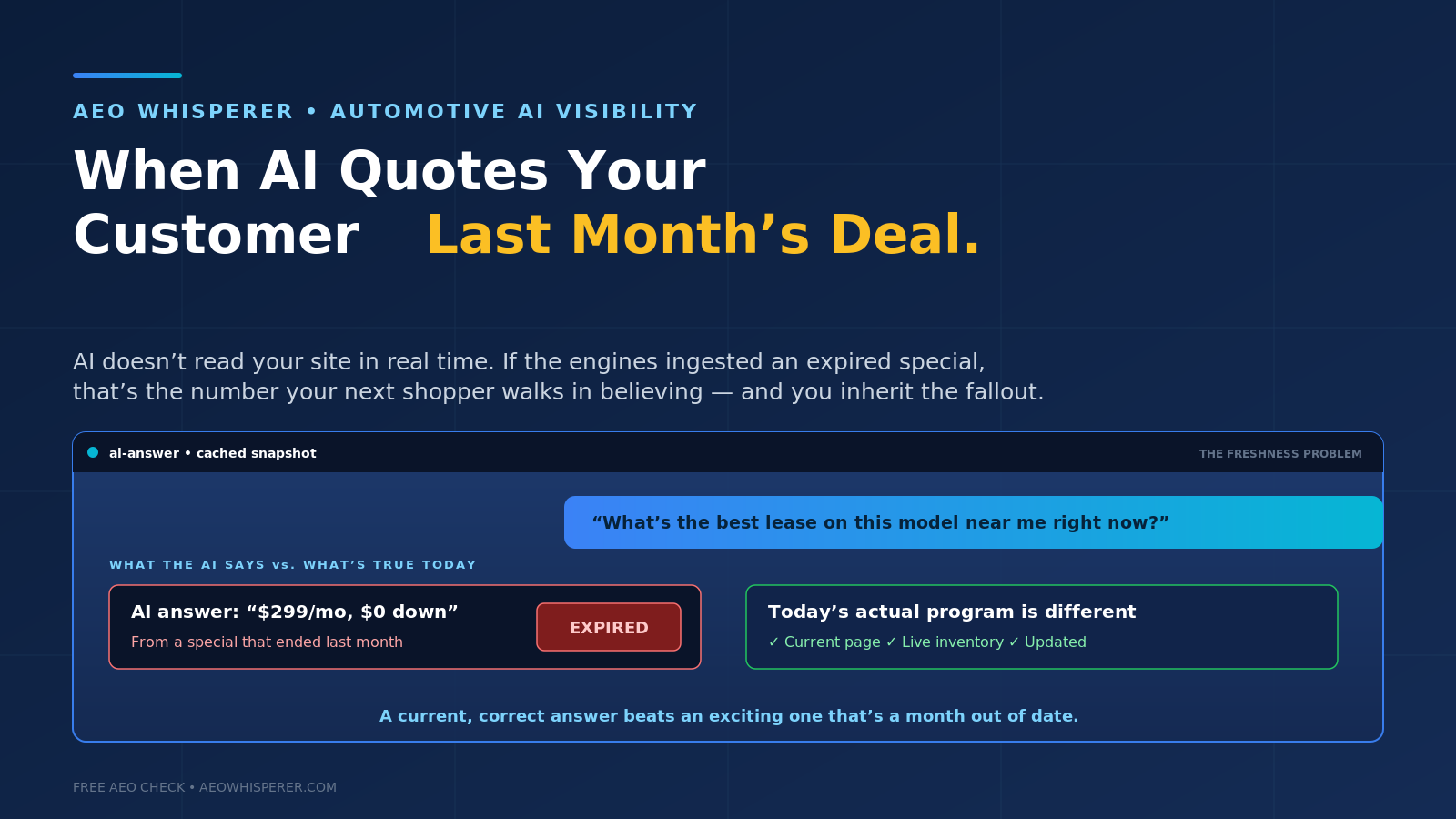
A customer walked onto my floor a couple of weeks ago holding his phone like it was a coupon. He'd asked an AI which dealer had the best lease on a particular model, and it told him we were running $299 a month with nothing down. Great, except that deal had rolled off at the end of the prior month. The new program was higher, and the incentive structure had changed entirely. So now my salesperson is starting the conversation by walking a guy backward off a number he'd already decided was real — and the customer is convinced we pulled a bait-and-switch. Nobody lied to him. The AI just handed him last month's deal and presented it like today's.
That's the freshness problem, and it's one of the quietest ways AEO can bite a dealership. We spend a lot of energy worrying about whether AI mentions us at all. We spend almost none worrying about whether what it says is current. And in our business, where pricing, incentives, and inventory turn over every single month, stale is its own kind of wrong.
AI doesn't read your site in real time
Here's the part that trips people up. When a shopper asks ChatGPT or Gemini about your store, the engine usually isn't pulling a live, this-second look at your website. It's leaning on a mix of what it crawled at some earlier point, what's cached, and what third-party sites said about you. That snapshot can be days, weeks, or in some cases months old. So if your March special is what the engine last ingested, March is what your April shopper hears — confidently, with no asterisk.
The trouble is that AI answers don't come with a "last updated" stamp the way a webpage does. A shopper reading an old number on your site might at least notice the expiration date in the fine print. A shopper hearing it from an AI just takes it as fact. The staleness is invisible to them, which means it lands on you to manage.
Why stale is worse than silent
You might think a slightly outdated answer is better than no answer. Usually it isn't. An old price sets an expectation you now have to break in person, and breaking it is exactly the kind of friction that kills trust before the test drive. The shopper doesn't think "the AI was out of date." He thinks "this store quoted me one thing online and another thing in the showroom." You inherit the credibility hit for a mistake you didn't make.
It's even rougher on the inventory side. AI tells someone you have the exact trim and color they want, they drive forty minutes, and it sold last week. That's a wasted trip and a sour first impression — and it traces straight back to a feed or a page that the engines read while it was already out of date.
What actually feeds freshness
The good news is that the same habits that make you findable also make you current — you just have to treat recency as part of the job. A few things move the needle more than people expect.
First, kill your expired pages. Those "April Lease Specials" and "Year-End Event" landing pages that never got taken down are landmines. If it's live, an engine can read it and assume it's true. When a program ends, the page comes down or gets updated the same week — not whenever someone remembers.
Second, date your content and keep your structured data honest. Pages that clearly show when an offer is valid, and inventory data that reflects what's actually on the ground today, give the engines a reason to trust the newer version over the older one. Conflicting signals — an old blog post saying one thing, your specials page saying another — let the AI grab whichever it saw first.
Third, mind the cadence. Sites that update regularly tend to get re-crawled more often, which means your changes get picked up faster. A store that refreshes its offers, inventory, and content on a real schedule is teaching the engines to come back. A store that posts a special and goes quiet for two months is teaching them not to bother.
Check it the way a shopper would
You don't need a software project to get a read on this. Pull up your store the way a customer would and actually ask the questions they ask. "What's the current lease on this model at [your store]?" "Do they have this in stock?" "What are the service hours?" Then check the answers against what's true today. If the engine is quoting a deal you've already retired, an SUV you already sold, or hours you changed last quarter, you've found a leak — and now you know which pages and feeds are feeding the engines stale information.
Do that once and I promise you'll never look at an old landing page the same way again.
Current beats clever
For all the talk about getting mentioned by AI, the dealers who win the next couple of years won't just be the ones the engines know about — they'll be the ones the engines describe accurately, today. A current, boring, correct answer about your store beats an exciting answer that's a month out of date every time, because the boring one doesn't blow up on your sales floor.
If you're curious what the engines are actually saying about your store right now — and whether they're quoting today's reality or last month's leftovers — the free AEO check at aeowhisperer.com runs real shopper questions through ChatGPT, Gemini, and Claude and shows you exactly how you come back. It takes about a minute, and it's a fast way to catch a stale answer before your next customer does.