When AI Gets Your Dealership Wrong: The Hallucination Problem Nobody Is Talking About
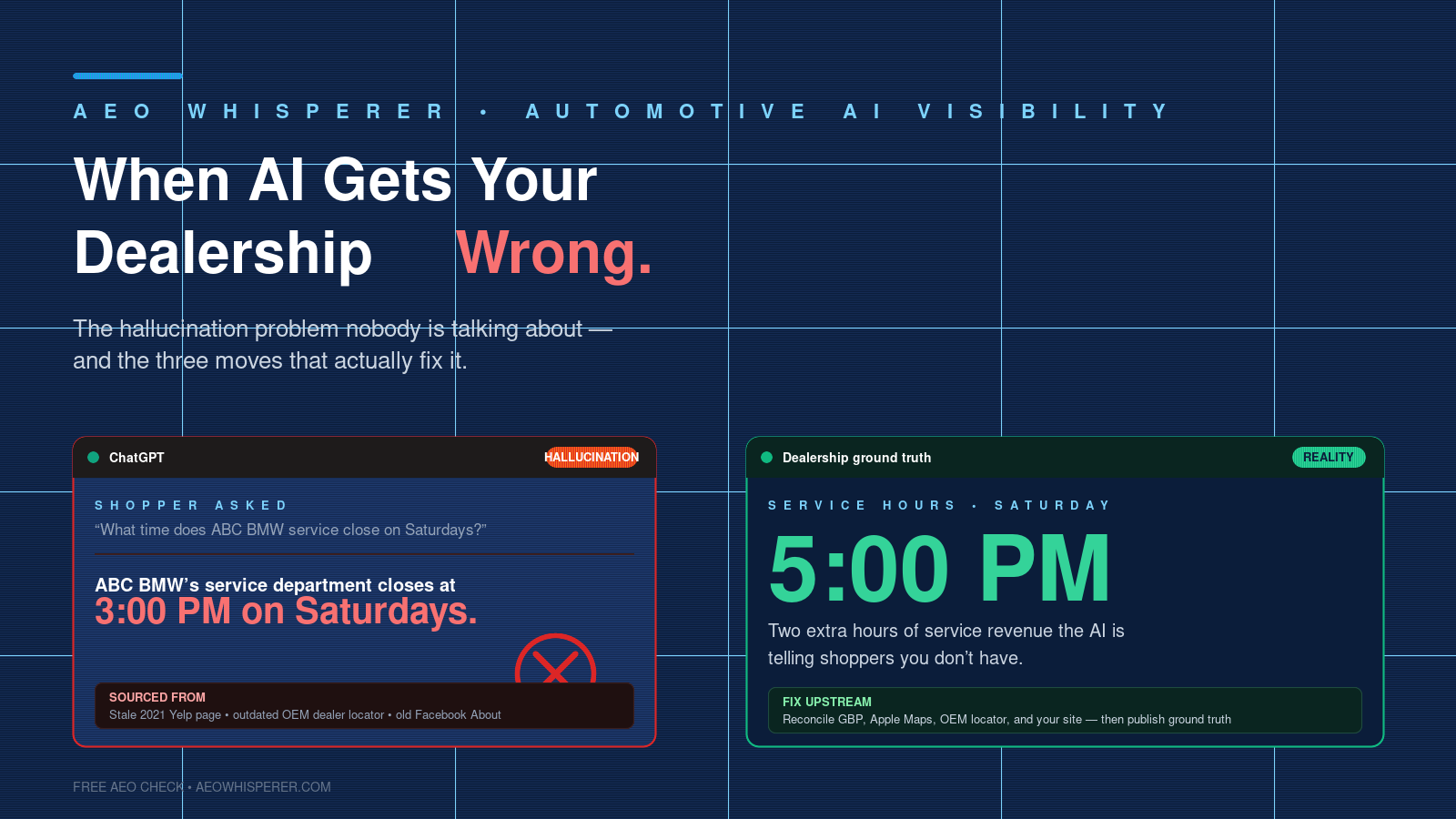
A peer of mine — a GM at a domestic store about an hour from me — called last month a little hot. He'd asked ChatGPT what time his service department closed on Saturdays. The answer came back confidently: 3:00 PM. His store closes at 5:00. He'd been losing the late-Saturday service customer for who knows how long because an AI was telling shoppers his shop was already shut.
That's the conversation I want to have. Not "is AI quoting you?" — we've covered that ground. The newer, sharper question is: what is AI saying about you that's flat-out wrong, and what do you do about it?
Hallucinations are not a bug. They are the default.
Large language models do not "look things up" the way a search engine does. They generate the most statistically likely next word based on the training data they've seen. When the training data on your dealership is sparse, contradictory, or outdated — which is the case at most franchise stores — the model fills the gap with whatever sounds reasonable. That's a hallucination, and dealers are uniquely vulnerable to them because our hours, inventory, staff, departments, and prices all change constantly while our public web footprint updates slowly.
I've run audits on a few hundred dealer brands at this point. The same four hallucination patterns show up over and over.
The four hallucinations I see most often
Wrong hours. The single most common one. The hours on your Google Business Profile, your Yelp page, your dealer website, and your OEM-hosted dealer locator often don't match. AI averages them or picks one at random. I've seen models confidently report Sunday hours for stores that have been closed Sundays for ten years.
Wrong departments. AI will tell shoppers you have a body shop you closed in 2019, or a Porsche service bay because Porsche service used to live in your building before the franchise moved. Old press releases live forever on the web, and the model treats them as current.
Wrong staff. This one stings. AI will name a service manager who left two years ago and recommend customers ask for them by name. Or it'll cite a F&I director who's now at a competitor. Bios get cached, LinkedIn lags, and old "meet our team" pages float around indefinitely.
Wrong pricing claims. "ABC BMW is known for offering $0 down lease specials on the X3." That kind of statement might have been true in a 2023 promo and still be sitting on a forum, a Reddit thread, or an old AdWords landing page somewhere. AI repeats it as a permanent fact, and you spend the next year explaining to customers why you don't actually do what the chatbot promised.
Why "just correct it" doesn't work the way you'd expect
Every dealer I talk through this with asks the same thing: "Can I just tell ChatGPT it's wrong?" Sort of, but no — not in any way that sticks. A correction inside a single user's conversation doesn't propagate to anyone else's session. The fix has to happen upstream, in the source material the model is trained on or pulls from at query time.
That means three concrete moves, in order:
One — audit your canonical sources until they all agree. Google Business Profile, Apple Maps, Yelp, your OEM dealer locator, your own website footer, your Facebook About page. Every single one needs to say the same hours, the same address, the same departments, the same phone number. Most stores fail this audit on the first pass and didn't know it.
Two — kill the stale pages. Old staff bios. Old promo landing pages. Old press releases announcing departments you've since closed. If your CMS won't let you delete them, set them to noindex and submit a removal request to Google. AI tools weight recency, but they also weight whatever they've already ingested, and the only way to age that data out is to stop feeding the page.
Three — publish ground truth aggressively. The most reliable way to overwrite a hallucination is to flood the model's feeding ground with a clean, current, schema-marked-up answer to the same question. Hours, departments, staff, current promos — write them, schema them, and republish them on a cadence so the freshest version of "what is true about ABC BMW" is always the version with the recent timestamp.
"Wrong" and "invisible" are roughly the same problem
The reason this matters is the same reason AEO matters at all. A shopper who gets the wrong answer about your store does not call you to verify it. They take the AI at its word and either come in frustrated or — far more often — never show at all. From a P&L perspective, "AI doesn't mention us" and "AI mentions us with bad information" both show up as missed traffic and weaker close rates, and we never see the receipt for either.
The dealers I see winning the AEO game are the ones who treat their public data the way they treat their inventory: as something that needs to be reconciled and refreshed every single week, not posted once and left alone for three years.
If you want to find out what AI engines are actually saying about your store right now — including whether they're getting basic facts right — run the free AEO check at aeowhisperer.com. The audit pulls live answers from ChatGPT, Gemini, and Claude on your dealership, broken out by sales, service, and used. It's the cheapest way to find out what your shoppers are hearing before they decide whether to call you.