Why AI Keeps Citing Cars.com Instead of Your Dealership's Website
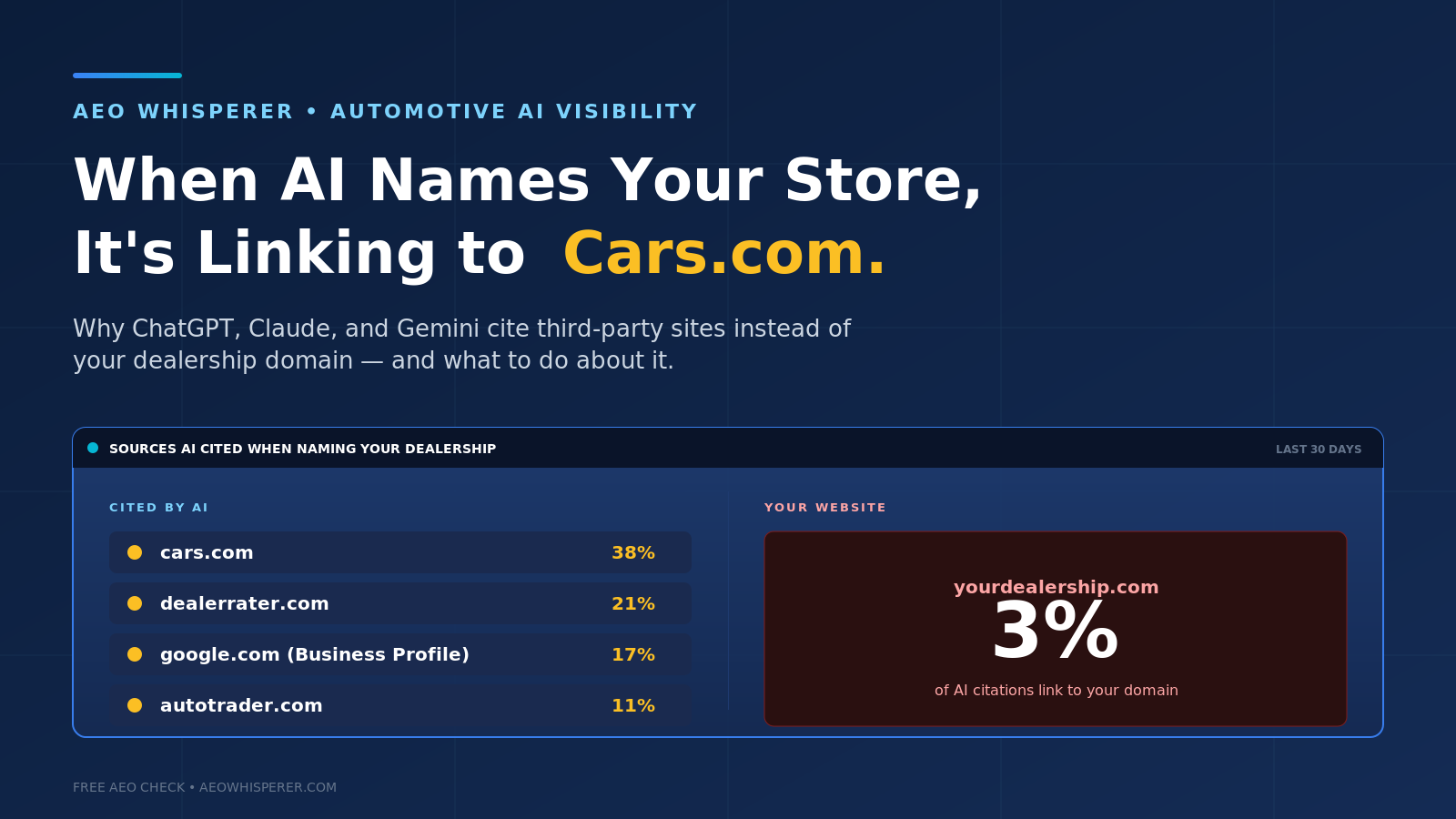
Here's a moment that should bother every GM. You ask ChatGPT, "What's the best BMW dealer in Somerset County, NJ?" and the answer comes back naming your store. Great. You scroll down to the little citation link AI dropped at the bottom of the paragraph, expecting your site. It's a Cars.com page. Or a DealerRater profile. Or your Google Business listing. Sometimes it's even the OEM corporate page. Almost never is it your dealership's own URL.
That's not a bug in the model. That's the model telling you exactly where it gets its information about you — and it's not from you. Once you see this pattern, you can't unsee it, and you'll understand why a recommendation from AI doesn't always turn into traffic on your site.
You're paying for that lead twice
Think about what happens when AI mentions you but links to Cars.com. The shopper clicks. They land on a third-party page that — by design — also shows them three other stores selling the same car, probably with lower prices, definitely with more reviews, and absolutely with a "Get Internet Price" form that routes to whoever wins the auction. You just got a recommendation from the most powerful new shopping engine in retail, and you handed the customer to a lead aggregator.
You're not just losing the direct visit. You're paying for the lead a second time the moment Cars.com sells it back to you. AI did the recommending. Cars.com is monetizing it. Your website never enters the picture.
Why AI picks Cars.com over your domain
There are four very specific reasons, and none of them are mysterious.
One — they have more structured data than you do. Cars.com publishes every VDP with full schema markup: price, mileage, VIN, photos, the works. Your DMS-driven dealer site usually has some of that, but in a less complete and less consistent way. AI models prefer pages they can parse cleanly. They cite what they can quote.
Two — your inventory only really lives on third-party feeds. If a shopper asks AI about a specific used vehicle, the path from question to answer often runs through the feed you send to AutoTrader and Cars.com, not through your own VDP. Those feeds are deeply indexed. Your VDP may not be.
Three — your review density is on someone else's domain. You probably have 800 Google reviews and 600 on DealerRater. Your own site has, maybe, a "What Our Customers Say" page with three rotating quotes. When AI needs proof that your store is reputable, it grabs the proof from where the proof is — Google, DealerRater, Yelp. Not from you.
Four — your About and team pages don't say anything quotable. "Family-owned since 1987. Serving the community with pride." AI can't cite that and won't. It's quotable when a page has specifics — names, tenure, awards, certifications, specialties. Most dealer About pages are wallpaper. Cars.com biographies, where they exist, are denser.
What to actually do about it
This is not a six-month project. It's a list of fixes you can put in motion this quarter.
Start with VDPs. Make sure every vehicle page has complete, valid JSON-LD structured data — price, availability, vehicle identification number, year/make/model/trim, mileage, drivetrain. If you have to choose one technical fix, this is it. Your web vendor knows how to do it; if they say they don't, that's a different conversation.
Then move review density onto your domain. Embed a verified Google review feed on your homepage, on every department page, and ideally on the VDPs themselves. Not curated quotes — the actual review widget that AI can read and attribute. The reviews will still live on Google. But they'll also live, machine-readable, on your site.
Beef up team and About pages. Real names. Tenure. Certifications. Brands worked on. Awards. The page should sound like a press kit, not a brochure. AI will quote a press kit. It won't quote a brochure.
Last, make sure your inventory pages are not just feed-driven but indexable in their own right. If your VDPs are JavaScript-rendered after page load with no server-side fallback, AI is not seeing them. Your inventory should be there in the source HTML, every time, for every vehicle.
Find out who AI is citing for your store
The first step is just seeing the pattern in your own market. Before you spend a nickel on this, you want to know exactly which third-party domains AI is currently leaning on when it answers shopper questions about your store. It might be Cars.com on inventory and Google on reviews — or it might look completely different in your zip code.
The free AEO check at aeowhisperer.com runs real shopper questions through ChatGPT, Gemini, and Claude and shows you what gets cited alongside your name — and what doesn't. It takes about a minute, and it gives you the actual answer to a question you probably haven't even asked yet: when AI talks about your dealership, who is it really sending the customer to?