When Your Next Shopper Sends an AI to Do the Car Buying
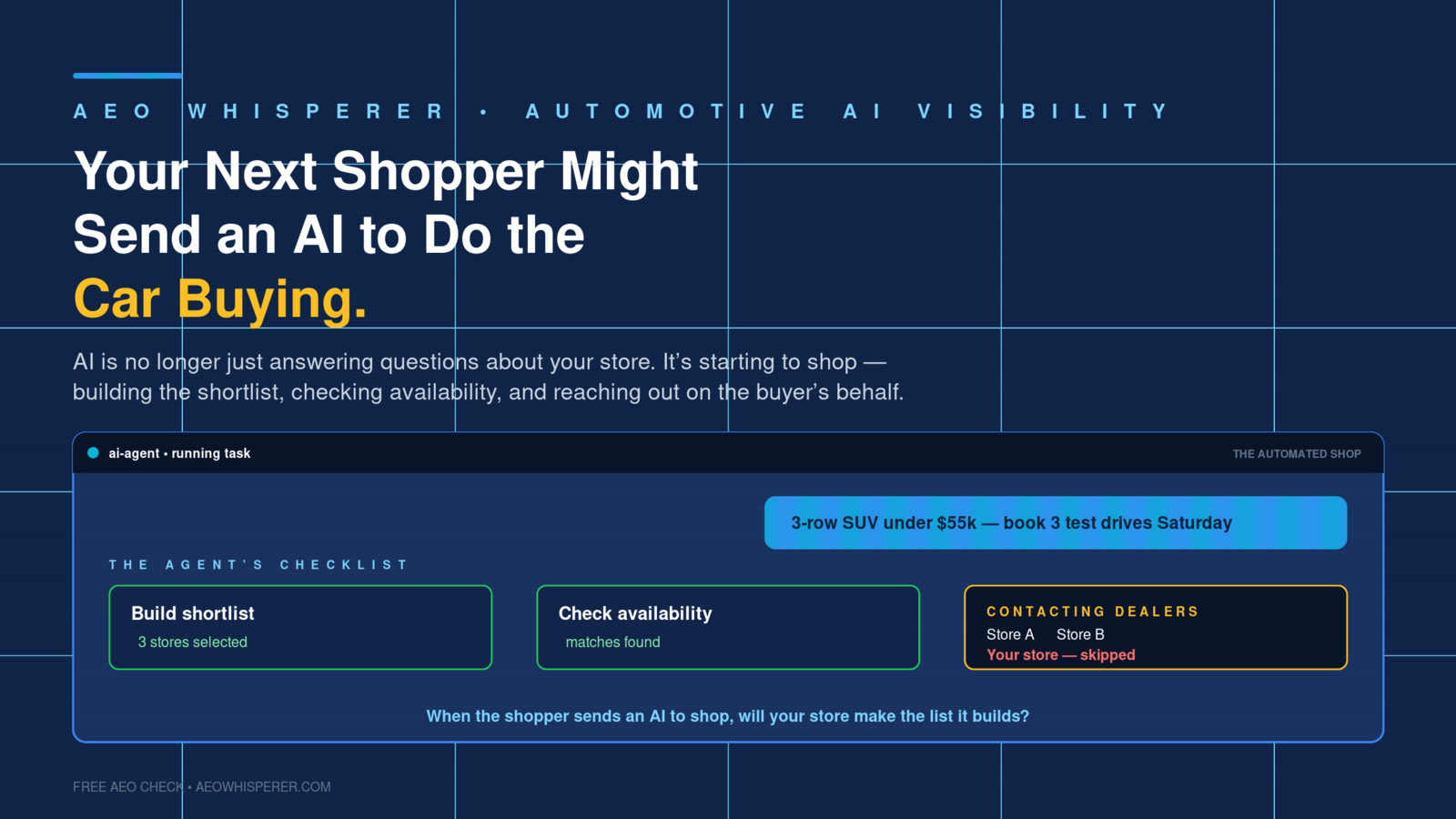
I sat in on a demo a few weeks back that I haven't been able to stop thinking about. Someone typed a couple of sentences into an AI tool — "I need a three-row SUV under $55k, I'm in central Jersey, line up three test drives for Saturday morning" — and then just let it run. The thing went off on its own, built a shortlist, checked what looked available, and started drafting the outreach to dealers. No tabs. No forms. No browsing. The shopper never opened a single dealership website. They sent a machine to do the shopping for them.
That's not science fiction anymore, and it's the next turn on the same road we've been driving for two years. First, shoppers started asking AI questions instead of Googling. Now AI is starting to act on those answers — research, shortlist, and reach out — on the buyer's behalf. If the last stretch was about whether AI mentions your store, the next one is about whether an AI agent will actually put you on the list and reach out for you.
From asking to acting
We've all gotten used to the customer who shows up "already sold" because they ran the question through ChatGPT or Gemini before they walked in. The agent shift takes that one step further. Instead of the shopper reading the AI's answer and then doing the legwork, the AI does the legwork. It decides which stores make the shortlist, which ones it bothers to contact, and how it describes each one to the buyer. The human stays in for the final call — but a big chunk of the top of the funnel just got handed to a piece of software.
Here's the part that matters for us: that software makes its decisions off the same layer we've been talking about all along. It reads the web — your site, your listings, your reviews, your structured data — and it builds a picture of your store from whatever it finds. A clean, consistent, legible picture gets you on the list. A messy or invisible one gets you skipped, and you'll never even see the lead that didn't happen.
"Agent-ready" is just AEO with the stakes raised
The good news is you don't need a brand-new playbook for this. An AI agent needs the exact same things a human-facing answer engine needs, just more reliably. It needs to know who you are without tripping over three different versions of your name, address, and phone. It needs to actually reach your site instead of bouncing off a blocked crawler. It needs your inventory, your hours, and your contact path in a form a machine can read — not buried in an image or a script it can't parse. And it needs clear, current answers to the questions a buyer would ask: what you carry, roughly what it costs, how to book a drive.
The difference is the tolerance. A human shopper who hits a confusing page will squint and figure it out, or call you anyway. An agent that hits the same page just moves on to the next store on its list. There's no benefit of the doubt. Friction a person pushes through, a machine routes around.
The lead you'll never see
The part that should get every GM's attention is that this failure is silent. When a salesperson loses a deal on the floor, you hear about it. When an agent quietly leaves you off a three-store shortlist because it couldn't confirm you had the vehicle, or couldn't find a clean way to make contact, nothing shows up in your CRM. No missed call to review, no abandoned form to chase. The opportunity simply never reaches you. You can't coach a loss you never knew about — and that's exactly the kind of loss this creates.
What to actually do this week
You don't have to chase every shiny new tool to get ahead of this. You have to be findable and readable to a machine. Pull up your own store the way an outsider would and check the basics. Does your name, address, and phone match everywhere an engine would look? Can a crawler actually get to your site, or are you quietly blocking it? Are your hours, your contact options, and a real link to live inventory easy to find and machine-readable? And if a buyer asked the simple stuff — "do you have this, what's it run, can I come Saturday?" — does your site answer it clearly somewhere, or does it make them dig? Close the gaps that would make an agent give up, and you've done most of the work.
The shortlist is the whole game now
For as long as I've been doing this, the job has been to get the customer onto the lot. The new version of that job is getting your store onto the shortlist the AI hands the customer — because increasingly, that list is the lot. The dealers who treat their digital presence as something a machine has to be able to read, not just something that looks nice to a human, are the ones who'll keep showing up when the shopping gets automated. The ones who don't will keep wondering why the floor traffic is thinning while their ad spend climbs.
If you want to know how the engines describe your store right now — and whether you're the kind of clean, findable result an AI would actually put on the list — the free AEO check at aeowhisperer.com runs real shopper questions through ChatGPT, Gemini, and Claude and shows you exactly how you come back. It takes about a minute, and it'll tell you fast whether you're on the list or getting skipped.