Before AI Recommends You, It Has to Know Who You Are
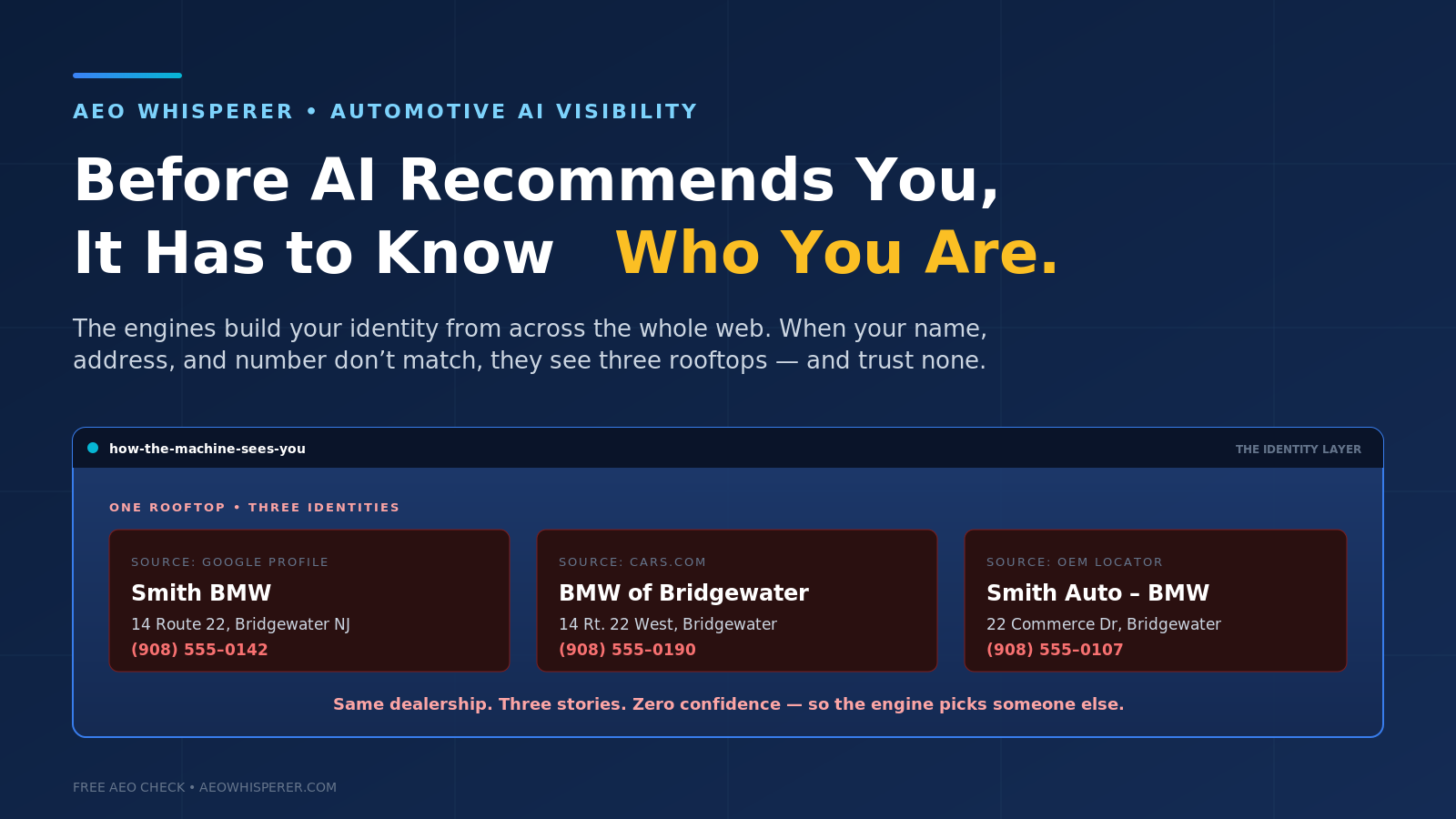
A few months back I went hunting for a problem in my own backyard. We'd cleaned up a couple of listings — corrected an old store name that traced back to a previous ownership — but some stale details were still floating around the web on directories nobody had touched in years. So I asked ChatGPT a dead-simple question: "Is there a BMW dealer in Bridgewater, NJ?" The answer it gave me blended two versions of my own store. Right rooftop, wrong phone number, a slightly different name — all delivered in that confident tone that makes a mess sound authoritative.
That's when it clicked for me. Before an AI engine can recommend you, it has to be sure who you even are. And a surprising number of dealerships are a blur to the machines.
AI builds a picture of you from the whole web — not just your site
The crawler and schema stuff I've written about lately is all about your own website: opening the door so the engines can get in, then labeling what's inside so they understand it. But when a shopper asks an engine about dealers in your market, it isn't only reading your site. It's stitching together a picture of you from everywhere it has ever seen your name — your Google Business Profile, Cars.com, Yelp, the BBB, your OEM's dealer locator, Facebook, old directory listings, even Reddit threads. When those sources agree on who you are, the engine is confident. When they contradict each other, it hedges, guesses, or quietly leaves you out in favor of a dealer whose story is cleaner.
Where the contradictions come from
You'd be amazed how easily one store ends up looking like two or three different businesses to a machine. A rebrand or an ownership change leaves the old name alive on directories for years. A moved rooftop leaves a stale address on a listing nobody updated. Service lists one phone number, sales lists another, and the OEM locator shows a third. The store reads as "Smith BMW" on one site, "BMW of Somewhere" on another, and "Smith Auto Group – BMW" on a third. To you and me, those are obviously the same place. To an engine matching text strings, they might be three separate rooftops — and none of them fully trusted.
None of this is a content problem. You can have the best inventory pages and the sharpest descriptions in your market, but if the engine can't pin down which dealership they belong to, a lot of that work goes uncounted.
Why this hits harder in the AI era than it ever did on Google
In the old Google world, you could show up across ten blue links and let the shopper sort out the details themselves. They'd click around, figure out which listing was current, and call the right number. AI engines don't work that way. They don't hand the shopper ten links — they hand them an answer, often a single recommendation or a short list. To make that call, the engine has to resolve you down to one confident, real business. If it can't, the safe move is to go with whoever it can identify cleanly. In other words, inconsistency doesn't just look sloppy anymore. It's a reason to get left out of the answer entirely.
What to actually check this week
You don't need a vendor or a big project for this one. Pull up your store the way a machine would and look for disagreement. Start with the basics — your exact dealership name, your address, and your main phone number — and confirm they read identically on your Google Business Profile, your website footer, your OEM locator, and the major third-party sites. Then go hunting for ghosts: old names, disconnected numbers, closed rooftops, duplicate listings left behind by a prior owner. Those are the contradictions that make an engine hedge. Where you find one, claim or correct the listing, or push the directory to merge the duplicate.
If you only fix one thing, make it this: get your dealership name and address to match word-for-word between your Google Business Profile and your own website. That pair carries a lot of weight with the engines, and it's the one I see quietly out of sync most often.
Get your story straight, and everything downstream starts working
I think of this as the third piece of the same job. First you let the engines in. Then you label what's on your site so they understand what they're looking at. And then you make sure that everywhere else they look, they find one consistent, real dealership — same name, same place, same number. Get all three right and your good content finally counts for something, because now the engine knows exactly who it belongs to.
If you want to see how the engines describe your store right now — and whether they've even got you straight as one business — the free AEO check at aeowhisperer.com runs real shopper questions through ChatGPT, Gemini, and Claude and shows you exactly how you come back. It takes about a minute, and it'll tell you fast whether the machines actually know who you are.