There’s a Hidden Layer on Your Website — and It’s What AI Actually Reads
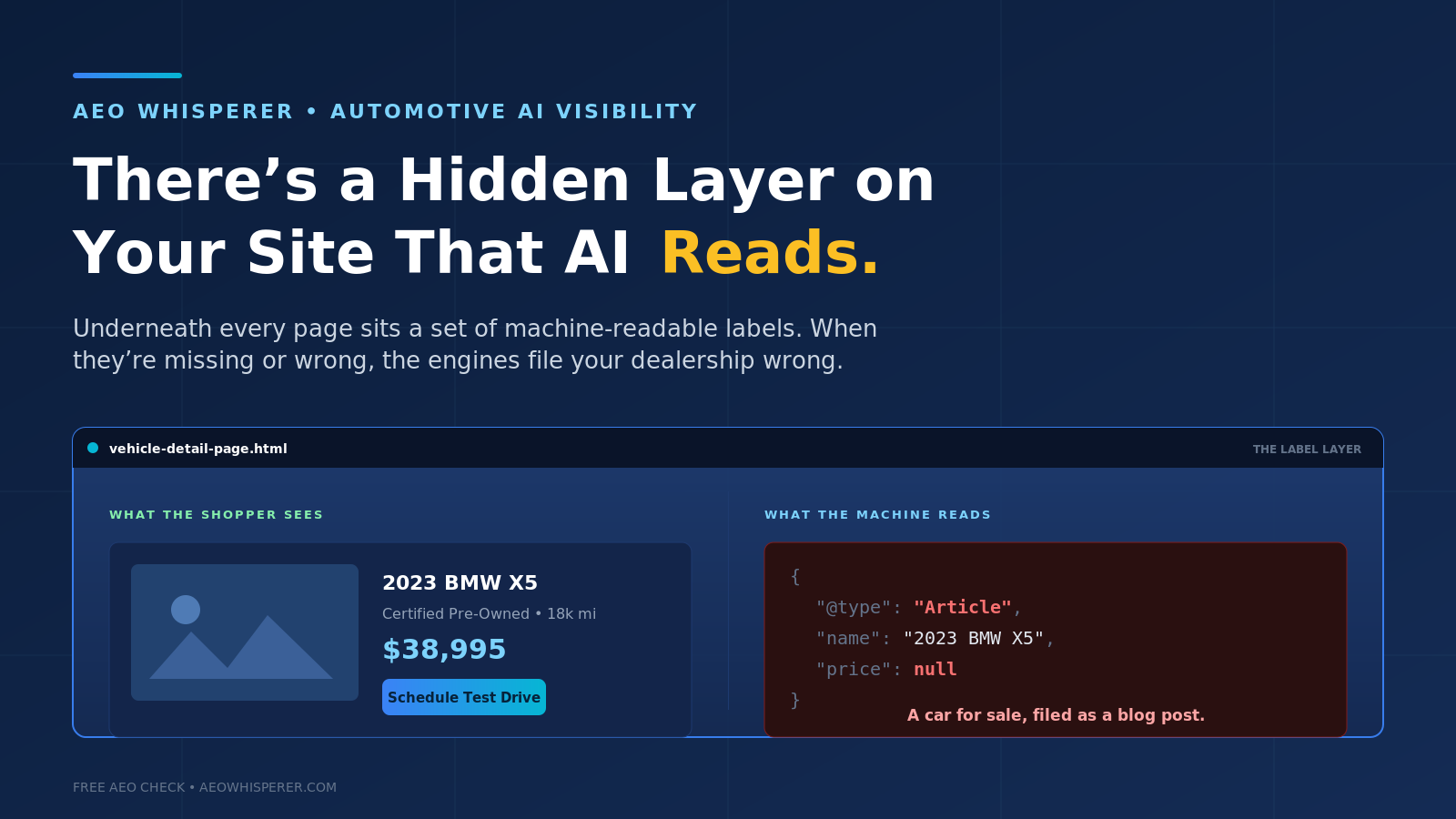
I had a webmaster on a screen share a few weeks back, trying to figure out why ChatGPT kept describing one of my used inventory pages as a "blog article." The page was a vehicle detail page. Photos, price, mileage, the whole thing — obvious to you and me. But the AI had it filed in the wrong drawer entirely. We dug into the page and found the answer in a place I'd never thought to look: the site was technically labeled wrong underneath the surface. To a human, it was clearly a car for sale. To a machine, it was an unmarked box.
That's the part of your website almost no GM has ever seen, and it's quietly shaping what the AI engines say about you.
The label layer underneath your website
Every page on your site has two versions. There's the one your customer sees — the photos, the price, the "Schedule Service" button. And there's a second version written in code, sitting in the background, that exists only to tell machines what they're looking at. That second layer is called structured data, or schema. It's a set of invisible labels that say, in a language built for computers, "this is a car dealership," "this is a vehicle for sale," "this is the price," "these are our service hours," "this is a customer question and here's the answer."
For years this was a Google SEO nicety — get the labels right and you might earn a fancier search listing with stars and prices. Useful, but optional. That's not the world we're in anymore.
Why the labels matter more now than they ever did
When a shopper asks ChatGPT or Gemini "which BMW dealer near Bridgewater has a certified X5 under 40 grand," the engine isn't reading your page the way a person does. It's moving fast, scanning thousands of sources, and it leans heavily on those structured labels to understand what's actually on a page and whether it answers the question. Clean labels are a shortcut that says, plainly, "here is a dealership, here is the inventory, here are the prices, here are the hours." No labels — or wrong labels — and the engine has to guess from the raw text, and it guesses badly. It mixes up your departments, misses your inventory, or files a car for sale under the wrong category.
The frustrating thing is that this has nothing to do with how good your content is. You can write the best vehicle descriptions in your market, but if the page never tells the machine "this is a vehicle for sale," a lot of that work goes uncounted.
Where dealers are actually losing this
Almost always, it traces back to the website vendor, and almost always it's invisible to the store. A few patterns I see over and over. The platform ships a generic template with thin or missing schema — maybe it labels the homepage as a business and calls it a day, with nothing telling the engines that your inventory pages are actual vehicles for sale. Or the labels exist but they're stale: hours that changed last year, a phone number from two ownerships ago, an address that points at your old rooftop. Or the schema is there but sloppy enough that the engines distrust it and fall back to guessing anyway.
In every case the store did nothing wrong and has no idea anything's off, because this layer is invisible unless you go looking. It doesn't show up on the page or in your analytics. It just quietly shapes what the machines believe about you.
What to actually do this week
You don't need to learn to code, and you don't need to touch this yourself. You need to ask the right question. Get your website vendor on the phone and ask them directly: "What structured data do we have on our inventory pages and our main dealership pages, and is it accurate and current?" Make them be specific. If the answer is vague, that's your answer.
Push them on three things in particular. Your main dealership pages should carry the proper business and department labels — new sales, used, and service, with correct hours, phone, and address. Your inventory pages should each be labeled as a vehicle that's actually for sale, with the price and key details marked up, not just sitting in plain text. And if you've built out a real FAQ page — and you should have — make sure those questions and answers are labeled as questions and answers, because that's exactly the format the engines love to pull from.
Get the labels right and the rest starts working
I think of this as the twin of the front-door problem I wrote about recently. First you make sure the AI engines are even allowed in. Then you make sure that once they're in, everything is labeled in a language they can read. Open door, clear labels. Skip either one and the best content in the world stays stuck behind glass.
If you want to see what the engines are actually saying about your store right now — and whether they've got your departments, your inventory, and your basics straight — the free AEO check at aeowhisperer.com runs real shopper questions through ChatGPT, Gemini, and Claude and shows you exactly how you come back. It takes about a minute, and it'll tell you fast whether the machines understand what your dealership actually is.