GEO vs. SEO: What's the Difference, and Why Your Dealership Needs Both
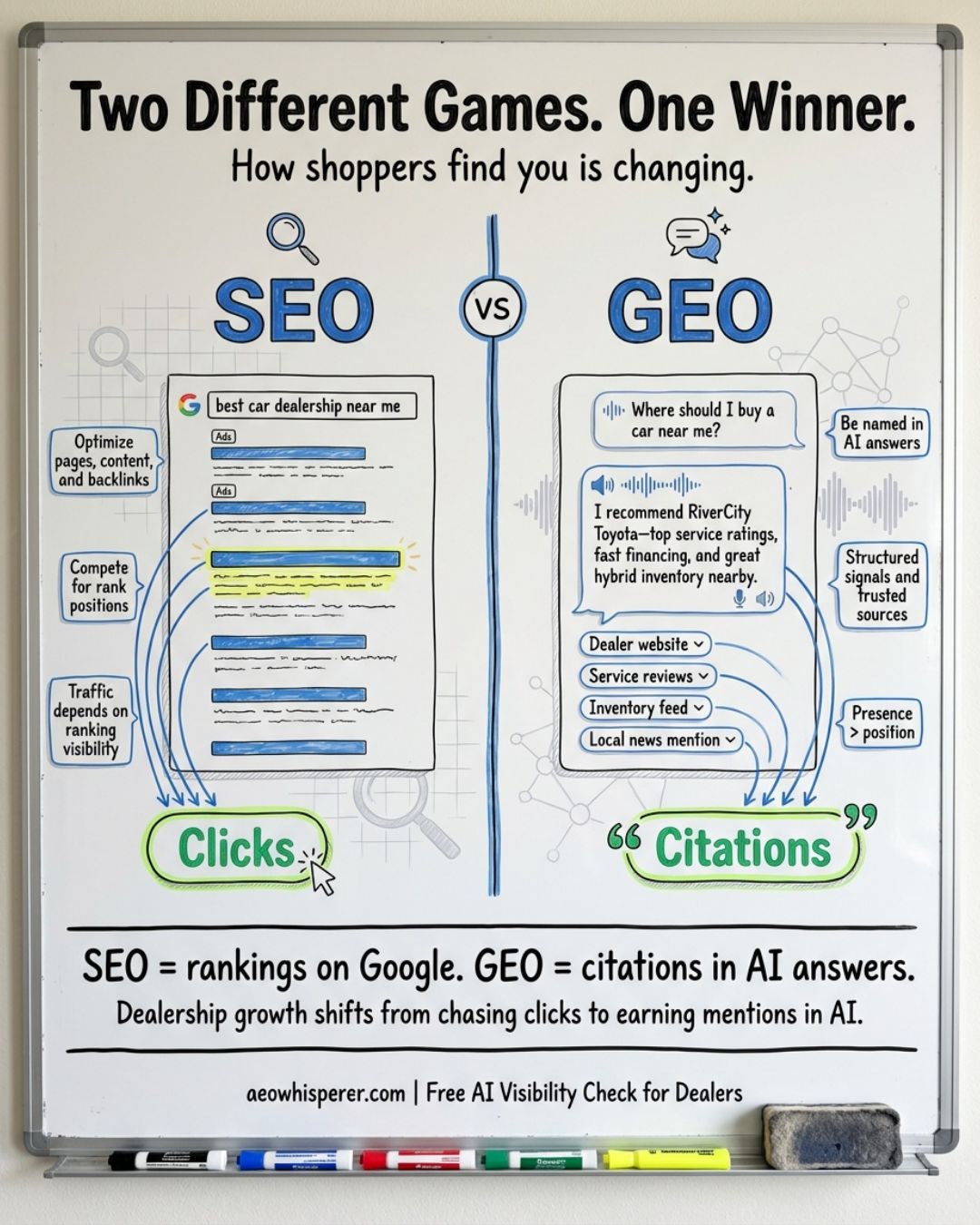
For the past two decades, "digital marketing" at a dealership basically meant one thing: SEO. Get your site ranked on Google, buy the right keywords, make sure your Google Business Profile was claimed, and call it a day. That playbook worked. It still works — for Google.
But a new playbook is forming, and most dealers haven't started reading it yet. It's called GEO — Generative Engine Optimization — and it determines whether AI mentions your store when a shopper asks ChatGPT, Gemini, or Claude a question about buying a car in your market.
SEO and GEO: Not the Same Game
SEO is about rankings. You optimize your website so Google's crawler can find, index, and rank your pages for relevant search terms. The output is a link on a search results page. The shopper clicks it — or doesn't.
GEO is about citations. You optimize your entire digital footprint so that AI language models can understand who you are, what you do, and why you're credible — and then reference you by name when generating an answer. The output isn't a link. It's a recommendation: "If you're looking for a reliable BMW dealer in the Bridgewater area, BMW of Bridgewater has strong reviews and a consistent reputation for transparent pricing."
That's a fundamentally different outcome, and it requires a fundamentally different approach.
Why GEO Is Harder Than SEO — and More Valuable
With SEO, you're optimizing for an algorithm that crawls your site and ranks it based on defined signals: backlinks, page speed, keyword density, structured data. It's opaque, but it's at least somewhat systematic.
With GEO, you're optimizing for AI models that were trained on enormous slices of the internet and are now synthesizing that information into conversational answers. They're not checking your site in real time. They're drawing on everything they've absorbed — your Google and DealerRater reviews, your OEM locator listing, forum posts mentioning your store, news coverage, your GBP responses, your website content, third-party inventory sites.
That means GEO isn't something you fix in one place. It's a signal built across your entire digital presence — consistent, accurate, and positive, everywhere.
The Three Pillars of GEO for Dealerships
1. Information consistency. AI models cross-reference your name, address, phone number, and hours across dozens of sources. If your GBP says you close at 8 PM but your website says 7 PM and a third-party aggregator says you're closed Sundays, the AI doesn't know which to trust — so it either hedges or skips you entirely. Fix the data, fix the foundation.
2. Review quality and recency. AI models don't just count your reviews; they read them. A dealership with 400 three-year-old reviews will often lose a citation battle to a competitor with 80 reviews from the past six months. The models weight recent sentiment heavily. Your review cadence matters more than your total count.
3. Authoritative content on your own site. AI models favor sources that answer questions — not just sell things. A dealership website that's nothing but SRPs and VDPs is largely invisible to GEO. A dealership site with real content — model comparisons, buying guides, service FAQs, finance explanations — signals expertise. That expertise gets cited.
Do You Need Both SEO and GEO?
Yes. Not every shopper is asking an AI — yet. Google still drives enormous dealership traffic, and abandoning SEO would be a mistake. The dealers who win over the next five years will be the ones who maintain strong SEO fundamentals while building their GEO presence in parallel.
The good news: the two overlap significantly. Strong GBP management, consistent NAP data, quality content, and active review generation help your Google rankings and your AI visibility. You're not starting from scratch — you're layering a new strategy on top of work you've already done.
The bad news: most dealers are doing zero intentional GEO work right now. That means they're invisible in AI answers even when a shopper is specifically asking about their brand and their market. That gap is winnable — but the window won't stay open forever as more forward-thinking competitors catch on.
Where Do You Actually Stand?
The honest first step is knowing your score. Most dealers have no idea how AI models describe their store, which competitors are getting cited over them, or what specific data gaps are costing them citations.
That's exactly what AEO Whisperer was built to surface. It runs your dealership against ChatGPT, Gemini, and Claude, gives you a visibility score across each model, and tells you specifically where the gaps are — so you can fix them.
Run your free AEO/GEO visibility check here. It takes about 60 seconds. No credit card. No sales call. Just an honest look at where your store stands in the AI era.
Follow AEO Whisperer
Stay up to date on AEO, GEO, and AI visibility for dealers: