Google Reviews Are AI Training Data Now. Here's What That Means for Your Dealership.
If you've been in the car business longer than a minute, you already know the review drill. You've sat in monthly meetings where someone slid a printout of your Google rating across the table. You've bonused service advisors on it. You've trained writers to ask for it. You've called Google Support when a customer left a 1-star out of pure spite. We've all done the dance.
For a long time, that dance was about one thing: the map pack. Higher star average, more reviews, better placement when somebody Googled "BMW dealer near me." That was the prize.
That prize just changed. And almost nobody on the dealer side has noticed yet.
Reviews aren't just ranking signals anymore. They're AI training data.
Here's what's happening behind the scenes when a shopper opens ChatGPT, Gemini, Perplexity, or Google's AI Mode and asks "what's the best BMW dealer in central New Jersey." That AI isn't checking your website first. It isn't crawling your VDPs. It's pulling from a stew of public data — your Google Business Profile, your Yelp, your DealerRater, your Edmunds reviews, your Cars.com reviews, and yes, every single review your customers have ever left online. The AI reads those reviews the same way it would read a New York Times article: as content. As facts about your store.
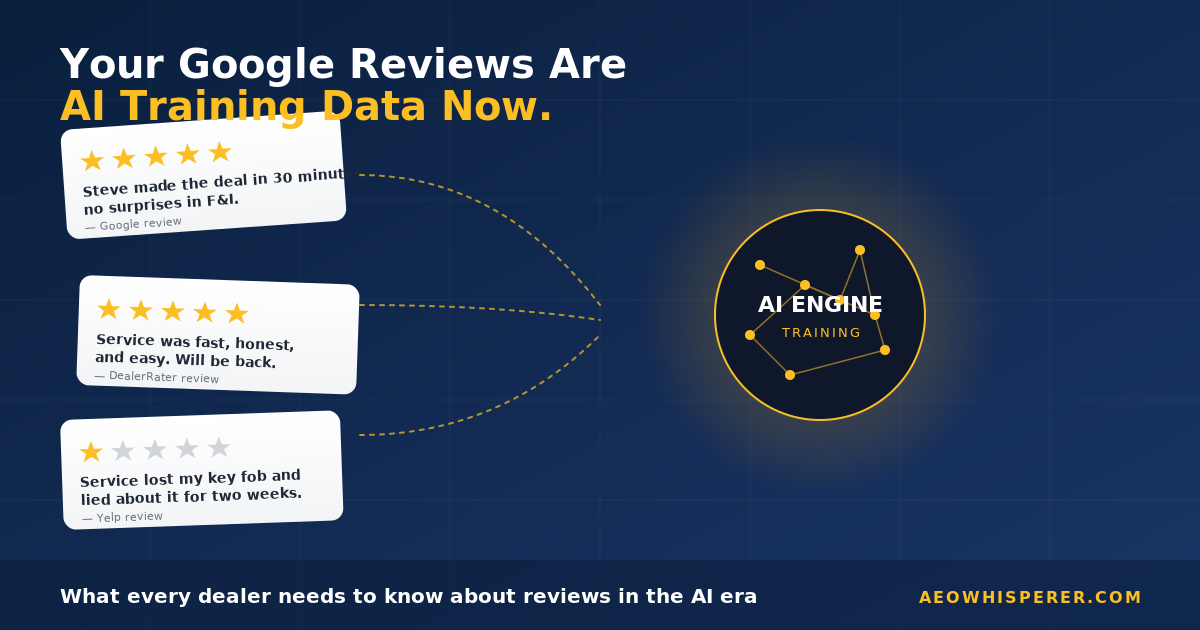
When a customer writes "Sales manager Steve was incredible, made the deal in 30 minutes, no surprises in F&I" — that's now a sentence an AI can quote, paraphrase, or use to rank your store ahead of the dealership down the road. When a customer writes "service department lost my key fob and lied about it for two weeks" — that's also now a sentence an AI can quote.
Every review, good or bad, is a tiny piece of training data telling the model what kind of dealership you are.
The hidden cost of bad service just got a lot bigger.
Here's the part that should keep every GM up at night. Used to be, a 1-star review cost you maybe a fraction of a star on your average and a few customers reading it on Google. Annoying, but containable. CRM follow-up, manager response, move on.
Now that same 1-star review can shape what an AI says about your store to thousands of shoppers — none of whom will ever see the actual review. They'll just see "this dealership has a reputation for poor communication in the service department," delivered in confident AI prose with no context, no chance for you to respond, and no way to even know it's happening.
The reviews aren't the audience anymore. They're the script.
What I'm doing about it at my store.
A few things have changed in how I think about reviews, and they should probably change at your store too.
I stopped treating reviews as a marketing problem and started treating them as an inventory of quotes that AI engines will eventually repeat. That means we read them more carefully. We respond to every single one — good and bad — within 24 hours, in the brand voice we want the AI to pick up. The AI is reading the response too.
I started auditing the language patterns. If our reviews are full of words like "fast," "easy," "honest," and "no pressure" — that's the language AI is going to use to describe us. If they're full of "wait," "confused," "fee," and "frustrating" — that's what the AI sees too. So we're coaching service advisors and salespeople on the verbatim phrases we'd love to see show up in reviews. Not gaming it — just making sure the experience matches the language we want associated with the store.
I started caring about where the reviews live. Google reviews still matter most, but DealerRater, Cars.com, Edmunds, Carfax, and Yelp all feed AI engines in slightly different ways. We push customers toward whichever platform is weakest for us that month, not the same default link every time.
And I'm watching for how AI describes the store, not just the rating. The number tells me how we're doing. The AI's prose tells me what we're known for. Those are two different scoreboards now, and most dealers are still only watching one.
The takeaway.
For 25 years, reviews mattered because Google said they did. Now they matter because every AI engine on Earth is reading them and turning them into the answer your next customer will hear before they even type your dealership's name into anything.
If you haven't checked what AI says about your store lately, you're flying blind. Your reviews are doing the talking — for better or worse — and you don't get to hear what they're saying.
You can run a free AEO check at aeowhisperer.com — it shows you what the major AI engines are actually saying about your dealership right now, side by side. Worth ten minutes if only to find out whether your reviews are working for you or quietly working against you.