Your Store Made the AI's List. Why Didn't the Shopper Pick You?
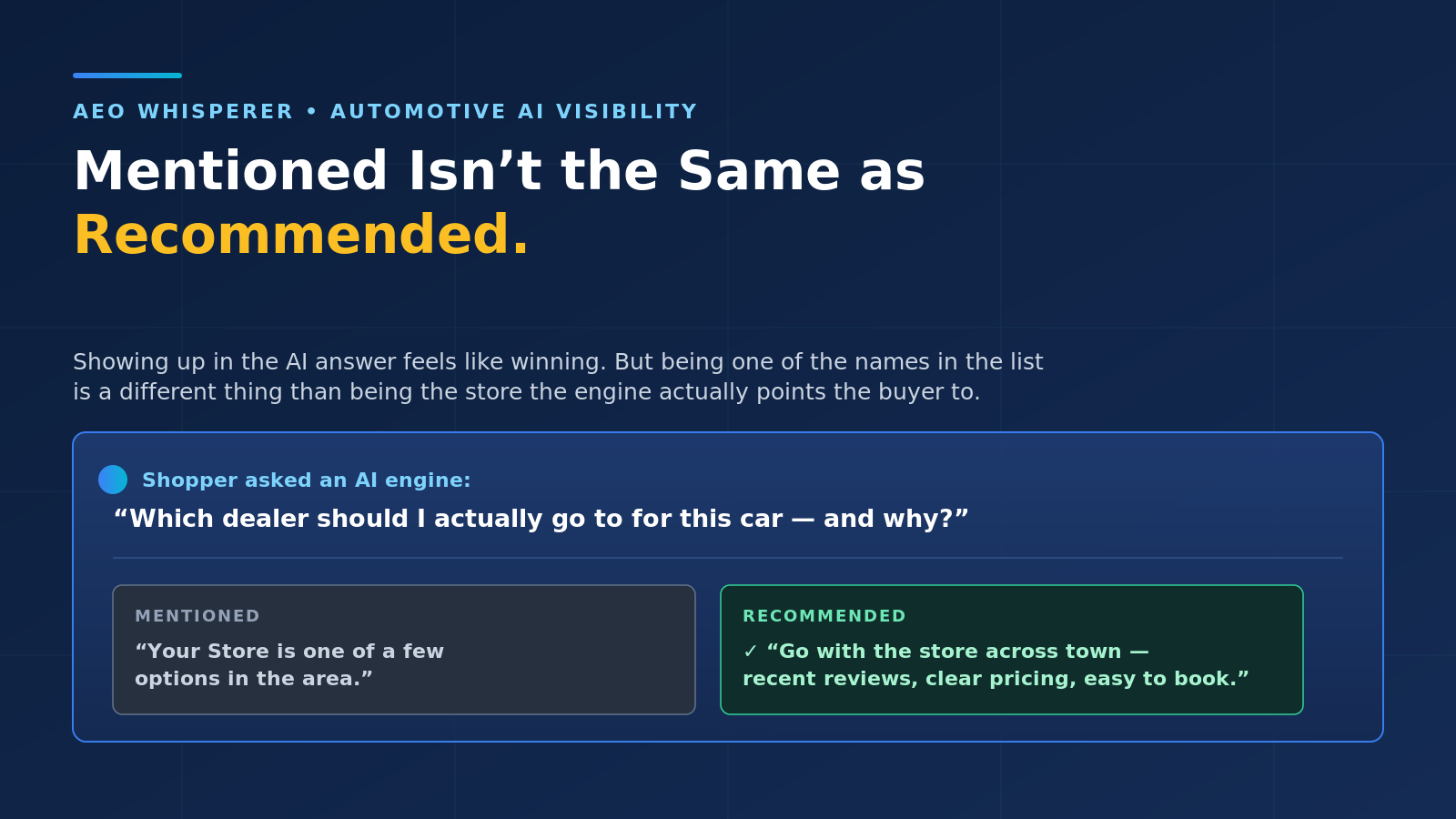
A customer told me last week that he found us through ChatGPT. Then he told me he bought from another store.
He'd asked the thing which dealers in the area to consider, and our name came back in the list — spelled right, sitting there next to three competitors. He saw it. He just didn't act on it. When I asked him why, he shrugged and said, "You were on there, but it kind of pushed me toward the other place." That sentence has been rattling around in my head ever since, because it points at something most of us are getting wrong about AI search. We've been so focused on whether we show up that we never stopped to ask the harder question: when we do show up, are we the answer, or just one of the names in the crowd?
Mentioned is not the same as recommended
There's a real difference between an engine listing your store and an engine steering a buyer toward it, and the gap between those two is where deals get quietly won and lost. A mention is your name appearing in a set of options. A recommendation is the engine leaning in — "this one's a strong choice because…" — and handing the shopper a reason to act. The second one is worth ten of the first, and it almost never shows up in the conversations we have about AI visibility. We treat "did we appear" as the finish line. The shopper treats it as the starting line.
Think about how you'd answer if a friend asked you to name a few good restaurants in town. You'd rattle off four or five. But if they pushed and asked where they should go Friday night, you'd narrow it to one and tell them why. AI does the same thing. Being on the long list is easy. Being the name it lands on when the shopper asks "so which one should I actually go to" is a completely different bar — and that's the bar that fills your showroom.
Why the engine lists you but won't lead with you
When an answer engine names your store but doesn't get behind it, it's usually because it couldn't find enough to say. It knows you exist. It knows roughly where you are and what you sell. But when it reaches for a reason to recommend you over the store down the road, it comes up empty — so it stays neutral, drops you in the list, and spends its enthusiasm on whichever competitor gave it more to work with.
The store that does get the nod usually isn't a better dealership. It's a more legible one. It has fresh, specific, consistent information the engine can point to — recent reviews that mention real experiences, clear answers to the questions buyers actually ask, pricing and process spelled out instead of hidden, and other sources around the web telling the same story about them. The engine isn't rewarding the best operator. It's rewarding the one it can describe with confidence. Confidence is the whole game, and most dealers hand the engine almost nothing to be confident about.
What tips a mention into a recommendation
Four things, mostly. Recency — the engine trusts a store that looks active this month over one that looks frozen in time, so a steady drip of fresh reviews and current content matters more than a big pile of old stuff. Specificity — vague "great service and selection" copy gives it nothing to quote; concrete details about your inventory, your process, and your people give it something to repeat. Corroboration — when your site, your Google profile, and third-party sources all say the same thing about you, the engine stops hedging. And clarity — if a buyer's basic question has a clean answer somewhere you control, you become the easy thing to recommend instead of the question mark it routes around.
None of that requires a new agency or a bigger ad budget. It requires treating your digital presence like something a machine has to be able to read and repeat — not just something that looks fine to a human skimming your homepage.
Check it the way the shopper does
Here's the exercise I'd run this week. Don't ask AI whether it's heard of your store — of course it has. Ask it the question your buyer actually asks: "Which dealer should I go to for a [your brand] in [your town], and why?" Then read what comes back hard. If you're not in it, you've got a visibility problem. But if you are in it and the engine has nothing meaningful to say about you while it gushes about the store across town, you've got the more expensive problem — the one you can't see in your CRM, because the shopper who quietly crossed you off never became a lead.
That's the real risk of getting comfortable with being mentioned. It feels like winning. It looks like you're in the game. And it can sit right on top of a steady leak of business going to whichever competitor gave the engine a better reason to point.
If you want to see exactly how the engines describe your store right now — whether they recommend you or just list you and move on — the free AEO check at aeowhisperer.com runs real shopper questions through ChatGPT, Gemini, and Claude and shows you how you come back. It takes about a minute, and it'll tell you fast whether you're the answer or just one of the names.