How AI Picks Between Same-Brand Dealers — And How to Make Sure You're the Pick
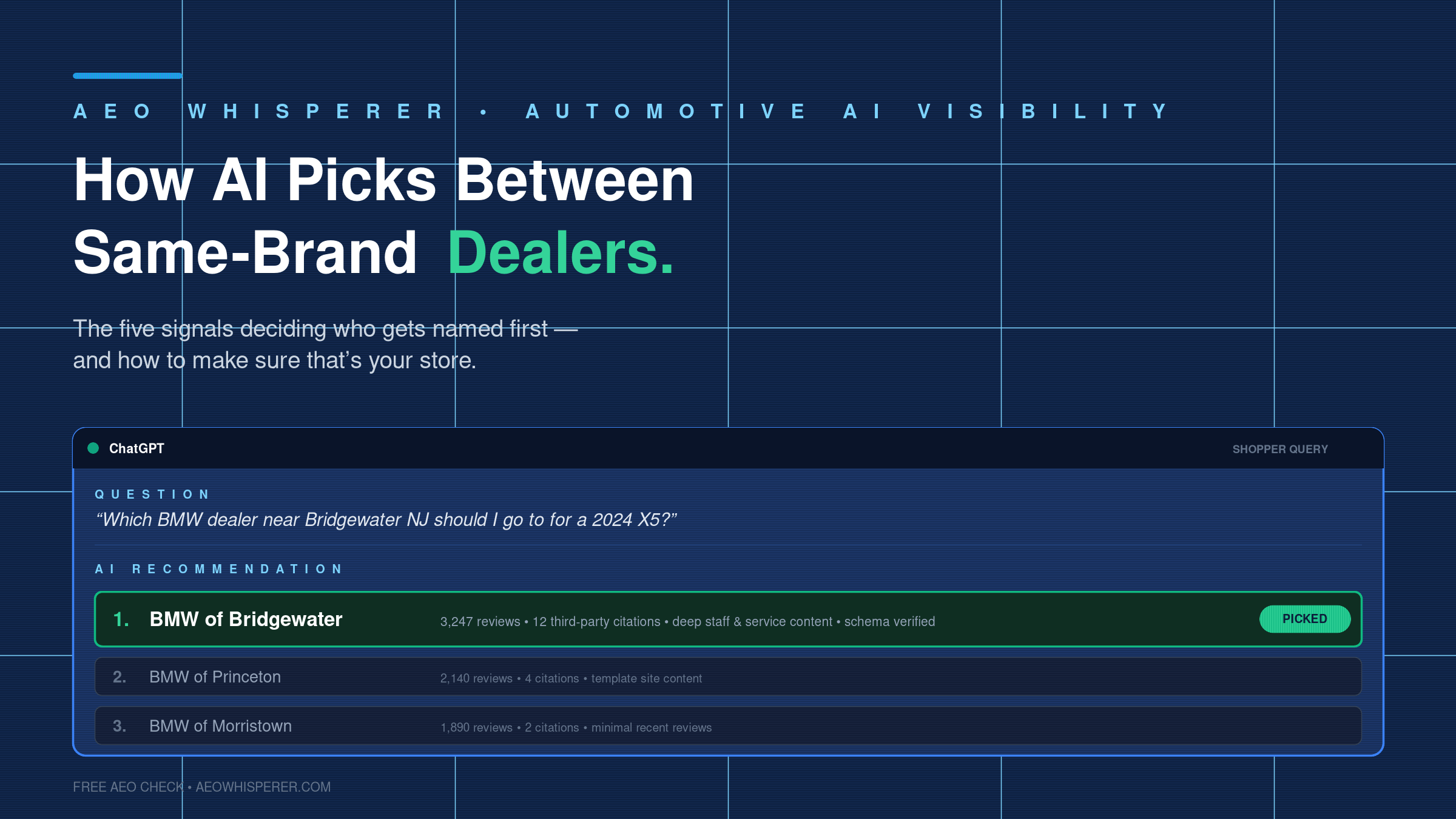
I ran a test the other night that bothered me more than I want to admit. I asked ChatGPT, Gemini, and Claude the same question a customer in my market would actually type: "I'm shopping for a 2024 BMW X5 around Bridgewater NJ — which dealer should I go to?"
Three different models. Three different answers. Two of them got my store wrong on a basic fact, one of them didn't mention us at all, and the one that did name us put a competitor 25 minutes farther away ahead of us anyway. I run a BMW store. We've been here a long time. We're not invisible to humans. But we were essentially invisible to the part of the funnel that's growing fastest.
That moment made something clear that's worth saying out loud to my fellow GMs: the brand on the marquee isn't a tiebreaker anymore. AI is doing the which store work that used to be done by an in-market shopper clicking around the OEM locator. And the criteria it's using are not the criteria most of us are optimizing for.
The new comparison shop is invisible
Here's what changed in the last 18 months. A shopper used to type "BMW dealer near me," see a Google map with five pins, click a few, and start judging based on photos, reviews, and price. That happened in their browser, in the open, and most of us could see it in our analytics.
Now a meaningful slice of those shoppers never sees the map. They open ChatGPT or Gemini, type a longer, more conversational question, and get back a paragraph that already named two or three "best" choices — and a reason. The shopper picks one. They never bounced through your homepage. You never saw the consideration happen. And the dealer that got named first now has a structural advantage you don't even know is hurting you.
The frustrating part is that the models are picking based on a small, learnable set of signals. Once you know what they are, this stops being mysterious.
The five signals that move the needle
After auditing a few hundred dealer queries across the three big LLMs through AEO Whisperer this year, the same factors keep showing up at the top.
Review volume and recency, not just star rating. A 4.7 with 3,200 reviews including 80 in the last 90 days will beat a 4.9 with 240 reviews and nothing recent. Models read recency as proof a dealer is currently operating well, not just historically. If your review intake stalled out two years ago and competitors didn't, that gap is being used against you.
Third-party citations. When DealerRater, Cars.com, Edmunds, Kelley Blue Book Consumer Reviews, or local media write about a dealership, those mentions act like external references. AI weights an answer it can cross-check against three sources higher than a self-claim it only sees on the dealer's own site. If your competitor is mentioned by name in a Cars.com "best of" roundup and you aren't, that's not cosmetic — it's structural.
Content depth on your own site. The dealers I see being named are ones with substantive content that goes past inventory and "about us" pages. Staff bios. Service explainers. Trim comparisons. Trade-in walkthroughs. Local context. AI is parsing for actual information density, and DMS-generated boilerplate registers as low-density, low-confidence content.
Schema and structured data. This one is more technical, but it matters. Stores with proper LocalBusiness, AutoDealer, FAQ, and Review schema markup get parsed more accurately. Stores running stripped-down templates get parsed as ambiguous, and the model defers to whichever competitor's data was clearer.
Local relevance. Place names, neighborhoods, highways, and regional context written naturally into your copy. "We serve drivers across Somerset County and the 287 corridor" is doing real work in a way "Serving Northern NJ since 1985" doesn't. The first phrase locks your store to a specific geography in a way AI can repeat verbatim.
What I'd do this week if I got buried
If a check came back showing my store ranked third or fourth among same-brand dealers in my market, I'd do three things before the end of the week. One, I'd pull review velocity for the last 90 days against my closest two competitors — if I'm behind, I'd put a 30-day push on it through the service drive, because that's where the volume is. Two, I'd audit my staff page and service explainer pages and rewrite anything that reads like it came from a template. Three, I'd get my web vendor on the phone to confirm the structured data is actually firing — most of them say it is, fewer of them are right.
None of this is mysterious work. It's just work that wasn't urgent two years ago and is urgent now.
If you're curious where your store actually sits in the AI comparison against your same-brand competitors, the free AEO check at aeowhisperer.com will tell you exactly that — across ChatGPT, Claude, and Gemini, broken out by sales and service. Most GMs I've shown it to are surprised by the first read. A few are upset by it. Both reactions are useful, because they're the first step to fixing it.