You Can't Forecast What You Can't See: How GMs Should Actually Measure AI Visibility
Every GM I know runs the store on numbers. Days' supply, gross per copy, CSI, closing ratio, cost per lead — we have a dashboard for everything. So at my last 20 Group meeting I started asking the room a simple question: what's your number for AI visibility? Blank stares. Every time.
That's the real problem. Most of us have already accepted that shoppers are using ChatGPT and Gemini to pick dealers — that debate is over. But almost nobody has a number for it. And in this business, what doesn't get measured doesn't get managed. It never makes the forecast, it never gets a line in the marketing budget, and it definitely never comes up in the Monday manager meeting. AI visibility has been sitting in that blind spot, and the blind spot is expensive.
Why this isn't just SEO rank tracking again
The natural instinct is to treat this like SEO — go find the AI version of a keyword rank report, pin it to the wall, and call it done. It doesn't work that way, and you need to know why before you waste a month looking for the wrong tool.
When you check a Google rank, the result is reasonably stable and it's the same for everybody — position six is position six, today and tomorrow. AI answers don't behave like that. Ask ChatGPT, Gemini, and Claude the same question about dealers in your market and you'll get three different answers, with different stores named in a different order, sometimes with different facts. Ask again next week and it can shift. There is no single "rank" to track. What you're actually measuring is closer to share of voice — across multiple models, across multiple shopper questions, watched over time. That's a different kind of number, and it's why the SEO dashboard you already pay for won't surface it for you.
The four numbers worth watching
You don't need a data science team for this. You need four numbers, checked consistently.
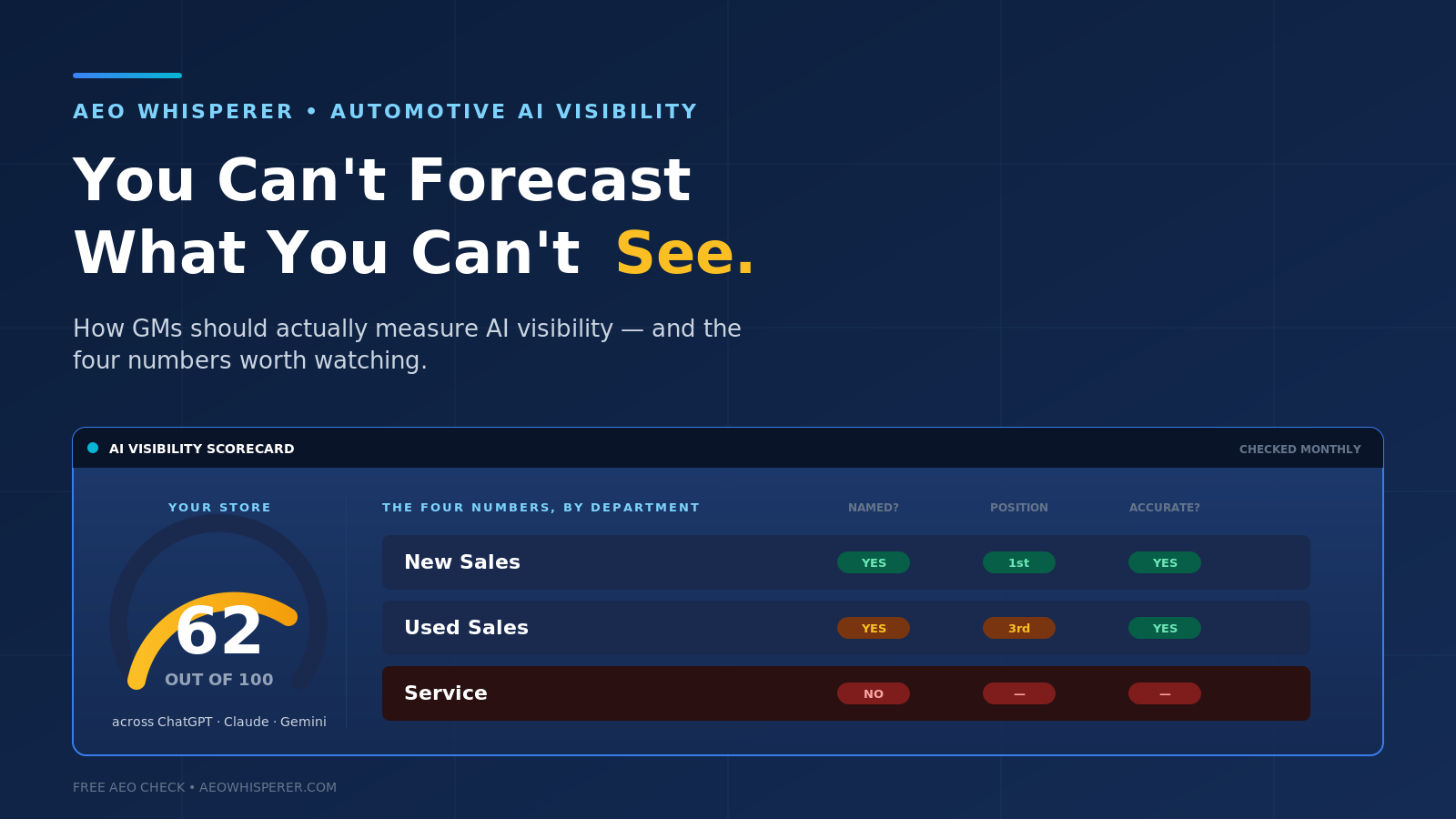
One: are you named at all. The most basic cut. When a shopper asks one of the big models for a dealer recommendation in your market, does your store come up — yes or no? If the answer is no, nothing else matters yet, and you've just found your first priority.
Two: where you land in the answer. Being mentioned third, after two competitors, is not the same as being the first name out. AI answers are short. First and second get the shopper; everyone else is a footnote. Track whether you're in the top group, not just whether you're present.
Three: is what it says accurate. Visibility with wrong information is its own problem — wrong hours, a brand you don't carry, a department you closed, a salesperson who left in 2023. An accuracy score matters as much as a presence score, because a confident wrong answer sends the deal somewhere else just as fast as no answer at all.
Four: the department breakout. New, used, and service are three different visibility problems. You can be the first name for new inventory and completely invisible for service. Measure them separately, or you'll average away the exact gap that's hurting you.
How often to check, and what good looks like
Cadence trips people up. Because the answers move, the temptation is to check daily and chase every wobble. Don't. Daily noise will make you crazy and won't change a single decision. Monthly is the right rhythm for a GM — frequent enough to catch a real slide, slow enough to actually see the effect of the changes you made. Treat it like a financial statement, not a stock ticker.
As for what "good" looks like — good is relative. The number that matters isn't an abstract score floating on its own, it's where you sit against the specific competitors you already worry about. If the same crosstown store is getting named first on all three models for used inventory, that's a defined, fixable gap. If you're the one getting named, that's a lead you want to widen before they notice it's there. Either way, you now have something concrete to bring to the table.
Put a number on it before the next manager meeting
The dealers who win the next few years aren't going to be the ones with the best opinions about AI search. They'll be the ones who turned it into a number, put it on the board, and managed it like everything else in the store. You can't forecast what you can't see.
If you don't have that number yet, the free AEO check at aeowhisperer.com is the fastest way to get one. It runs real shopper questions across ChatGPT, Claude, and Gemini and shows you exactly where your store stands — named or not, first or footnote, accurate or not — broken out by new, used, and service. It takes about a minute. And it gives you the one thing this whole problem has been missing: a starting number.