Your Next Up Already Asked AI About You — Before They Walked In
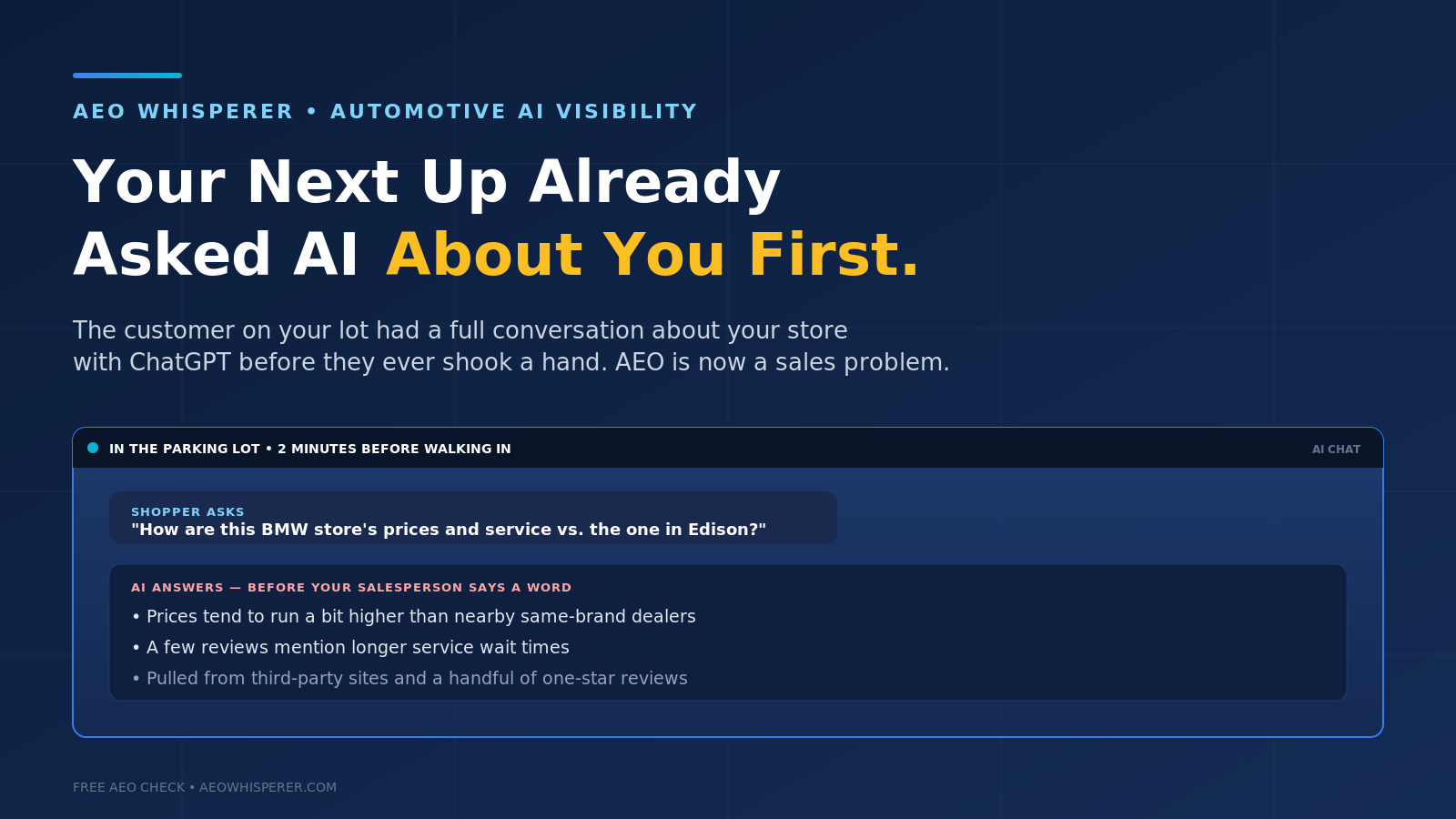
Last week I walked the showroom floor and watched one of my best salespeople get caught flat-footed. The customer — a fresh up off the lot, hadn't filled out a single form — opened with, "So I know your X3 lease is running about forty more a month than the dealer in Edison, and I read your service department has a bit of a wait problem." My guy hadn't even gotten to "welcome in." The customer already had a position, a comparison, and an objection. And he got all of it from ChatGPT in the parking lot.
We spend a lot of time talking about AEO as a top-of-funnel marketing problem — how to show up when shoppers ask AI for the best dealer near them. That's real. But there's a second shift happening that hits much closer to the desk: the customer who does walk in has often already had a full conversation about you with an AI before they ever shook a hand. The up isn't AI's first stop anymore. It's the last one.
The pre-loaded customer is the new normal
Think about how your own people shop now. Nobody walks into a decision cold. Before my customer drove over, he'd asked an AI engine three or four questions: Is this a reputable BMW store? How do their prices compare? What do people say about their service? Are there any complaints I should know about? By the time he hit the lot, he wasn't gathering information — he was confirming a story that was already written. And he didn't write it. ChatGPT did, using whatever it could find about my store.
That's the part that should make every GM sit up. The opening frame of the sale — the customer's expectations, their comparison set, their objections — is increasingly being set by a machine you've never audited, pulling from sources you may not even know it's reading. Your salesperson used to control the first ten minutes. Now they're often walking into the middle of a conversation that started somewhere else.
What AI is actually handing your customer
Here's the uncomfortable exercise. Open ChatGPT or Gemini and ask it the questions your real customers are asking: "Should I buy from [your store]? How are their prices and their service?" Read the answer the way a skeptical shopper would.
In a lot of cases, three things happen. First, the AI leans on your reviews — but it weighs the angry one-stars heavily because they're specific and quotable, while your hundreds of happy reviews get summarized into a bland "generally positive." Second, it compares you to the same-brand store down the road using whatever pricing and inventory signals it can scrape, which may be stale or pulled from a third-party feed rather than your own site. Third, when it doesn't have good information about you, it doesn't say "I don't know" — it fills the gap with a generic or occasionally flat-out wrong description of your store. Your customer reads all of that as fact before they ever meet your team.
This is a sales problem now, not just a marketing one
I think the mistake dealers make is filing AEO under marketing and walking away. But the customer who arrives quoting an AI is a sales-floor reality. If the engine told them your prices run high, your salesperson opens forty dollars in the hole. If it surfaced a two-year-old service complaint, your service drive is on the defensive before a single RO is written. The story AI tells about you isn't an abstract visibility metric — it's the first objection your team has to overcome every single day.
And it cuts the other way too. When AI gets your store right — accurate pricing context, your real reputation, your actual specialties — your salesperson walks into a customer who is already leaning in. The same tool that can hand your competitor an opening can hand you a warm one. The only variable is whether the information AI is working from came from you or from somebody else.
What to actually do about it
Start by reading what AI says about you, out loud, in your next sales meeting. Not a vendor's dashboard — the actual answers, the way a customer sees them. It changes the room. Your team stops treating "the internet" as a vague force and starts seeing the specific story they're being asked to sell against.
Then fix the inputs. Get accurate, current review responses on the public record so AI has something better than a one-star to quote. Make sure your own website carries the pricing, inventory, and reputation signals you want represented, instead of leaving the engine to pull from third-party feeds. And give your team a simple playbook for the AI-coached up: ask what they've already read, correct the record calmly, and use it as a trust-builder instead of a landmine.
See the story before your customer does
You can't coach your team against an objection you've never heard. The whole point is to know exactly what ChatGPT, Gemini, and Claude are telling shoppers about your store before the next up walks in repeating it.
The free AEO check at aeowhisperer.com runs real shopper questions through all three engines and shows you the story AI is telling about your dealership right now — across new, used, and service. It takes about a minute, and it'll tell you exactly what your sales floor is up against tomorrow morning.